Every comparison of MCP vs REST API for cold email you will read leads with the same question: which one is faster, which one is easier to set up, which one scales. That framing is comfortable because it is the framing we use for every other integration decision. It is also the wrong one for outbound.
Speed and setup time are real differences, and the standard comparison gets them mostly right. But they are the least important differences when the action on the other end of the call is an email leaving your domain and landing in a stranger's inbox. You cannot un-send it. You cannot un-burn a domain. The moment the payload is an irreversible external action instead of a read, the decision stops being about throughput and becomes about blast radius - how much damage a single wrong call can do, and who is holding the trigger when it fires.
This post reframes the choice around that. If you want the mechanics of exposing your outreach actions to a model in the first place, tool calling for cold email APIs covers the wiring. This is about the decision one level up.
What the two things actually are
Quickly, so we are talking about the same objects.
A REST API for cold email is a set of stateless HTTP endpoints. Each request carries its own authentication and parameters, the server does the work and forgets you. Your code decides when to create a lead, enroll it in a campaign, or send a reply. The intelligence - the "when" and the "which" - lives in software you wrote.
MCP, the Model Context Protocol, is an open standard published by Anthropic in November 2024 for connecting AI models to external tools. An MCP server exposes your actions as typed tools with names, descriptions, and JSON input schemas. The agent discovers those tools at runtime and calls them over a stateful JSON-RPC 2.0 session. The intelligence moves into the model. If you have never seen the protocol up close, what MCP actually is walks through it.
Here is the comparison table you have seen a dozen times, because it is accurate as far as it goes.
| Dimension | REST API | MCP |
|---|---|---|
| State | Stateless per request | Stateful session |
| Discovery | Endpoints hardcoded by you | Tools discovered at runtime |
| Who decides the action | Your application code | The model |
| Transport | HTTP / JSON | JSON-RPC 2.0 over stdio or HTTP |
| Best fit | Deterministic, high-volume pipelines | Adaptive, agent-driven workflows |
Nothing there is wrong. The problem is that it is the same table you would draw for connecting an agent to a weather service or a B2B data provider, and cold email is not a weather service.
Reads are cheap. Sends are not.
Almost every MCP-vs-REST comparison on the web is written for a read-heavy job: connect the agent to enrichment data, to a CRM lookup, to a knowledge base. In those jobs the worst case of a wrong tool call is a wasted request. The agent fetches the wrong record, you shrug, it fetches again.
Cold email inverts that. The primary action is a write to the outside world that you do not control and cannot recall. A misfired send is not a wasted request. It is:
- A real email in a real prospect's inbox, possibly the wrong one, possibly to a suppressed contact who already asked you to stop.
- A mark against your sending domain's reputation that compounds if the agent repeats it.
- In some jurisdictions, a compliance event with actual liability attached.
The asymmetry is the whole point. An agent that reads too much is inefficient. An agent that sends too much is dangerous. The integration surface you choose decides how easy it is to cross that line.
This is why the "which is faster" question misleads. One analysis of MCP for agent workflows measured a few hundred milliseconds of discovery and reasoning overhead per call versus a direct REST request, and called it negligible for adaptive workflows. For cold email it is beyond negligible - it is invisible, because sends are paced across hours and days by warmup and rate limits, not fired in a hot loop. Nobody has ever lost a deal because their cold email send took 400 milliseconds longer. Plenty have lost a domain because a system sent a thousand emails it should not have.
The real axis: who owns the irreversible action
Reframed around blast radius, the choice becomes clearer.
REST keeps the trigger in your code. The model, if there is one, produces text or a suggested action, and your application decides whether to execute it. Every send passes through logic you wrote and can audit. The blast radius of a model mistake is bounded by your code, because the model never touches the send directly. This is the right default when you do not yet trust an agent to act unsupervised, or when the workflow is fixed enough that runtime decisions add nothing.
MCP hands the trigger to the model. That is the entire value proposition - the agent decides which lead to enroll, how to phrase a reply, when to pause a campaign, without you scripting each branch. It is genuinely more capable. It is also a larger blast radius by construction, because the thing deciding to send is a probabilistic model, not your if statement.
Neither is safer in the abstract. What makes MCP safe for cold email is not the protocol - it is whether the tools you expose through it are safe to hand to a model that will occasionally be wrong. That responsibility moves down a layer, into the sending infrastructure itself.
The variable nobody in these comparisons prices in
Read any of the popular MCP-vs-REST writeups and notice what is missing: not one of them mentions deliverability. That is a strange omission for outbound, because deliverability is the constraint that actually decides whether cold email works at all.
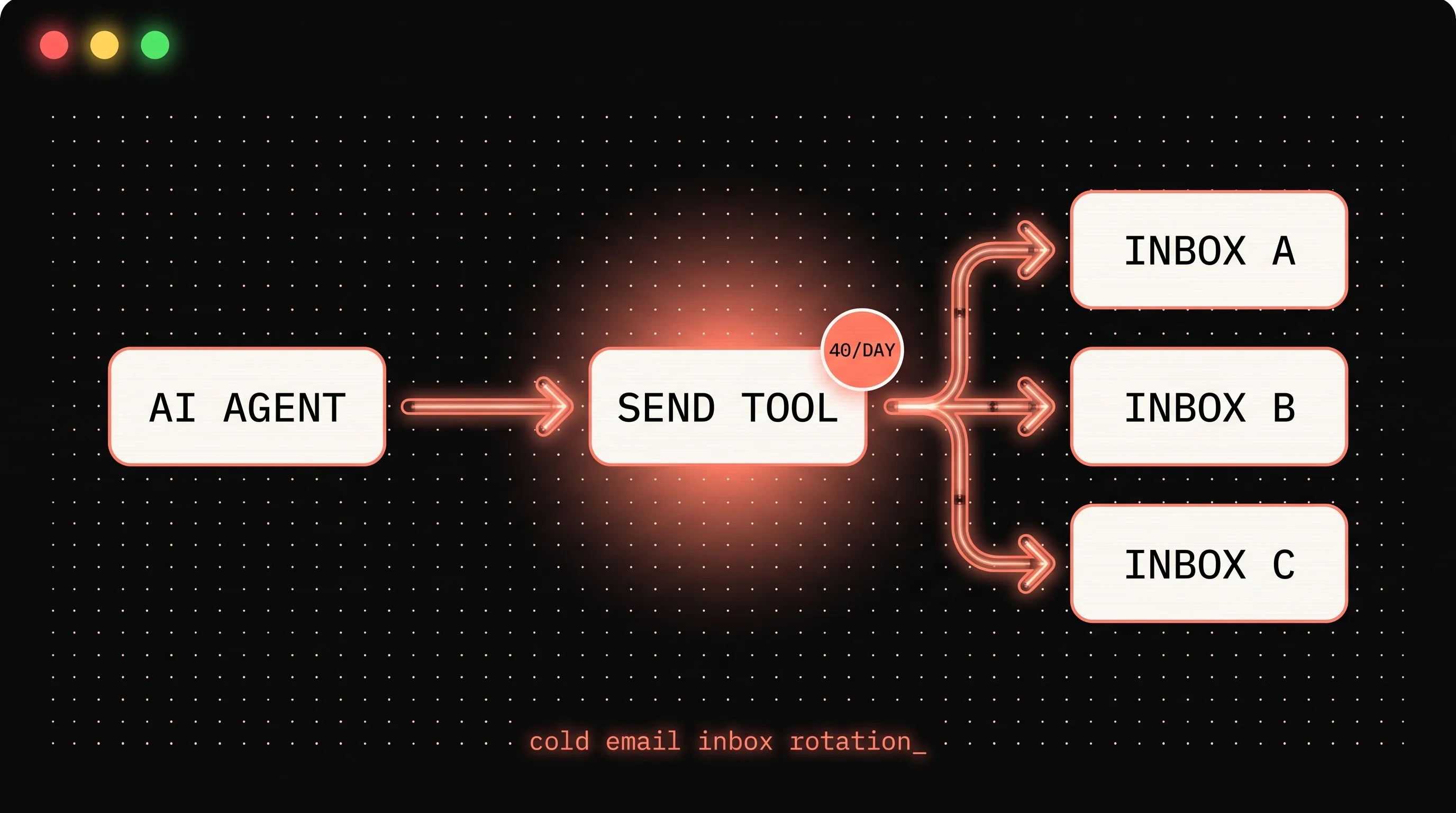
The protocol does not affect inbox placement. Volume, warmup, authentication, and list quality do, and a send request looks identical to a receiving mail server whether it arrived over MCP or REST. But MCP changes the probability of the failure mode that wrecks deliverability, because it introduces an autonomous actor that can push volume. If your sending layer does not enforce its own rate limits, suppression list, and reputation-aware throttling, an agent with an MCP tool can exceed a domain's safe capacity in minutes. We wrote about this specific failure mode in AI agent cold email deliverability: autonomous sending burns domains when the guardrails live in the prompt instead of the infrastructure.
The lesson is that the MCP-vs-REST decision is downstream of a more important one. Before you expose sending to an agent at all, the sending layer has to enforce, server-side and regardless of caller:
- Rate limits and warmup ramps the agent cannot override.
- Suppression and unsubscribe checks on every single send, not as a courtesy the model is trusted to remember.
- Approval gates for anything above a threshold, so a human stays on the loop for the risky actions. This is the human-in-the-loop cold email pattern, and it is not optional for autonomous send.
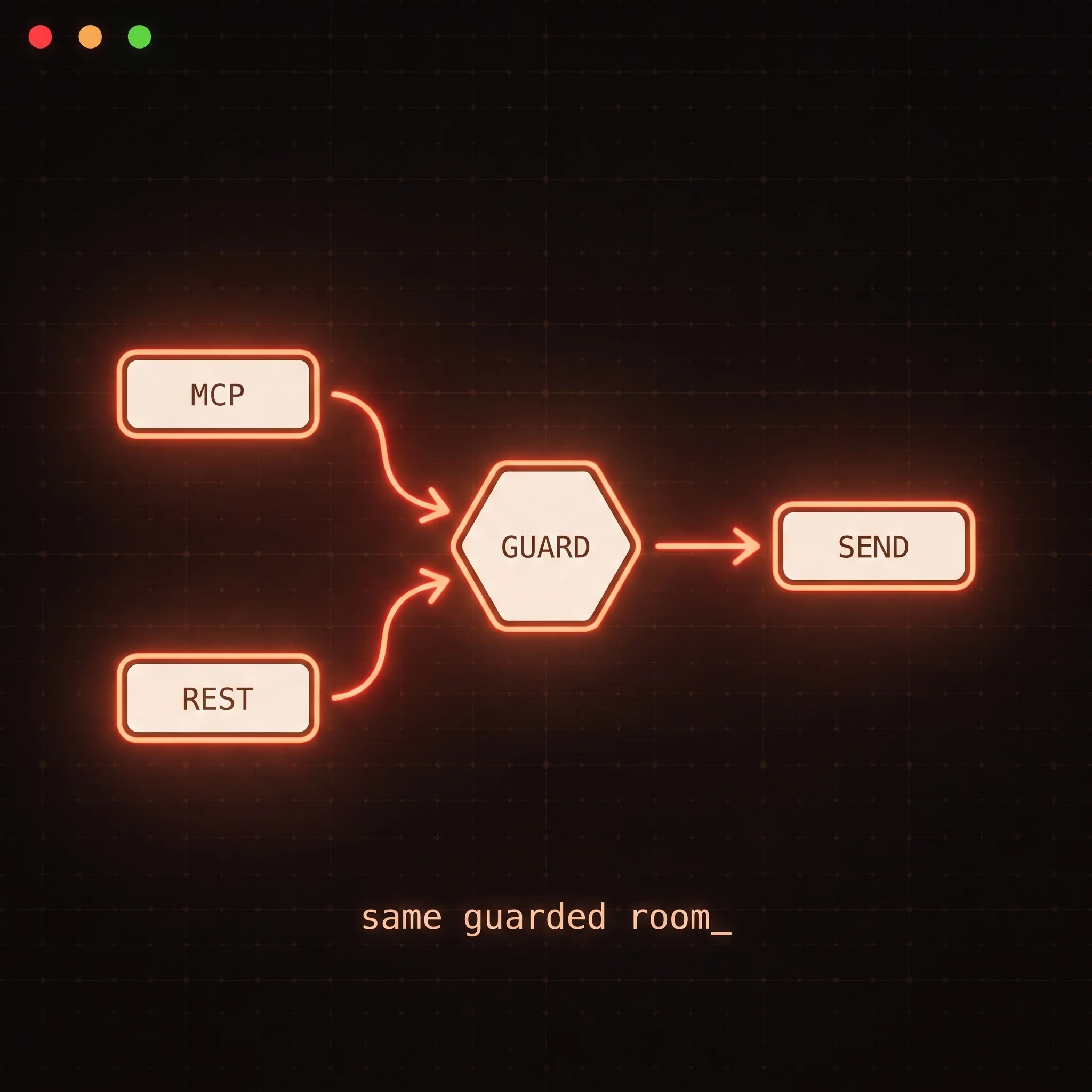
Once those rules live in the tool, MCP is safe to offer, because the worst a confused agent can do is bounce off a guardrail. Without them, neither surface is safe - REST just fails slower because a human is usually in the loop by accident.
A decision framework that admits when not to use MCP
Most comparisons quietly assume MCP wins for anything touching an agent. It does not. Here is the honest version.
Use REST or an SDK when the workflow is deterministic - a nightly job that enrolls a fixed list, a webhook handler that files replies into a CRM, a bulk import of ten thousand leads. Runtime reasoning adds latency and risk with no upside. A cron script and a typed client are simpler, cheaper, and easier to audit. If you are on a code-first framework like LangChain or the OpenAI Agents SDK, a Python SDK over REST already gives your agent the actions without the MCP layer.
Use MCP when the value is the agent deciding at runtime - triaging a messy inbox, choosing which of two hundred leads deserves a personal reply today, pausing a campaign because a reply signaled the timing is wrong. These are judgments you cannot pre-script cleanly, and they are exactly what a model is good at. MCP also wins when the agent runs inside a client that speaks the protocol natively, like Claude Desktop or Cursor, where a hosted cold email MCP server means zero custom glue per client.
Run both when you are past the toy stage, which is most real stacks. REST and webhooks move bulk data and receive events. MCP sits on top for the decisions. The two are not competitors; they are layers. The only rule that matters is that the guardrails live below both, in the send infrastructure, so it does not matter which surface makes the call.
Decision shortcut: if a wrong call wastes a request, optimize for capability and reach for MCP. If a wrong call sends an email, optimize for blast radius first and only expose the action once the tool enforces its own limits.
Where this actually goes
The MCP-vs-REST framing will keep getting written as a performance bake-off, because that is the shape of every other integration comparison and it is easy to fill a table with. But the useful version of the question is not which protocol is faster. It is which layer owns the irreversible action, and whether that layer can be trusted with a model on the other end.
The direction of travel is clear enough. Agents are going to own more of the reasoning - which lead, which message, which moment - and that reasoning increasingly wants to reach the send directly rather than through a human relay. That is fine, and even good, on one condition: the send has to become a governed tool call, with the rate limits, suppression, and approval gates enforced in the infrastructure rather than assumed in the prompt. When outreach is built that way, the choice between MCP and REST stops being scary, because both are just doors into the same guarded room. That is the model FoxReach is built around, and the cold email MCP server is where the guarded room lives - the full picture for agent-native outreach shows how the layers fit together. Pick your protocol for the workflow. Put the guardrails a level below it, and the protocol stops being the risk.