
The 2026 definition
An AI SDR is an agent that handles the outbound stage of sales without a human in the loop. It picks leads, drafts messages, sends, triages replies, and hands off qualified prospects to an Account Executive. In 2022 this was a pitch deck. In 2024 it was a demo with many disclaimers. In 2026 it is a stack you can build in a week.
The shift happened for three reasons - LLMs got reliable enough to write a B-minus cold email without supervision, MCP gave agents typed tools for outbound infrastructure, and the people who actually do cold email stopped pretending that humans + Instantly is a workable long-term strategy at any scale above 50 leads a day.
This post defines the role, what the job actually looks like in production, and the stack you need to run one that works.
What a human SDR actually does
Before defining the AI version, be honest about the human version. A good SDR in 2025-2026 does roughly six things:
- Lead sourcing. Find prospects that match an ICP definition. Use LinkedIn Sales Navigator, Apollo, ZoomInfo, or a custom scraper.
- Research. Read about the prospect and their company. Recent funding, role change, product launches, public pain points.
- Personalization. Write the opener that references the research and the pitch that fits the research.
- Sequencing. Drop into a multi-step cadence - initial email, follow-up 1, follow-up 2, LinkedIn touch, break-up email.
- Reply triage. Classify replies - interested, not now, wrong person, unsubscribe. Route each appropriately.
- Meeting booking. Qualify and hand off to an Account Executive, or book on the AE's calendar directly.
An AI SDR handles all six, with varying quality. The first four are now genuinely agent-solved in 2026. The last two (triage + booking) are the frontier - some teams are running them end-to-end, most still gate the handoff with a human.
What an AI SDR actually is
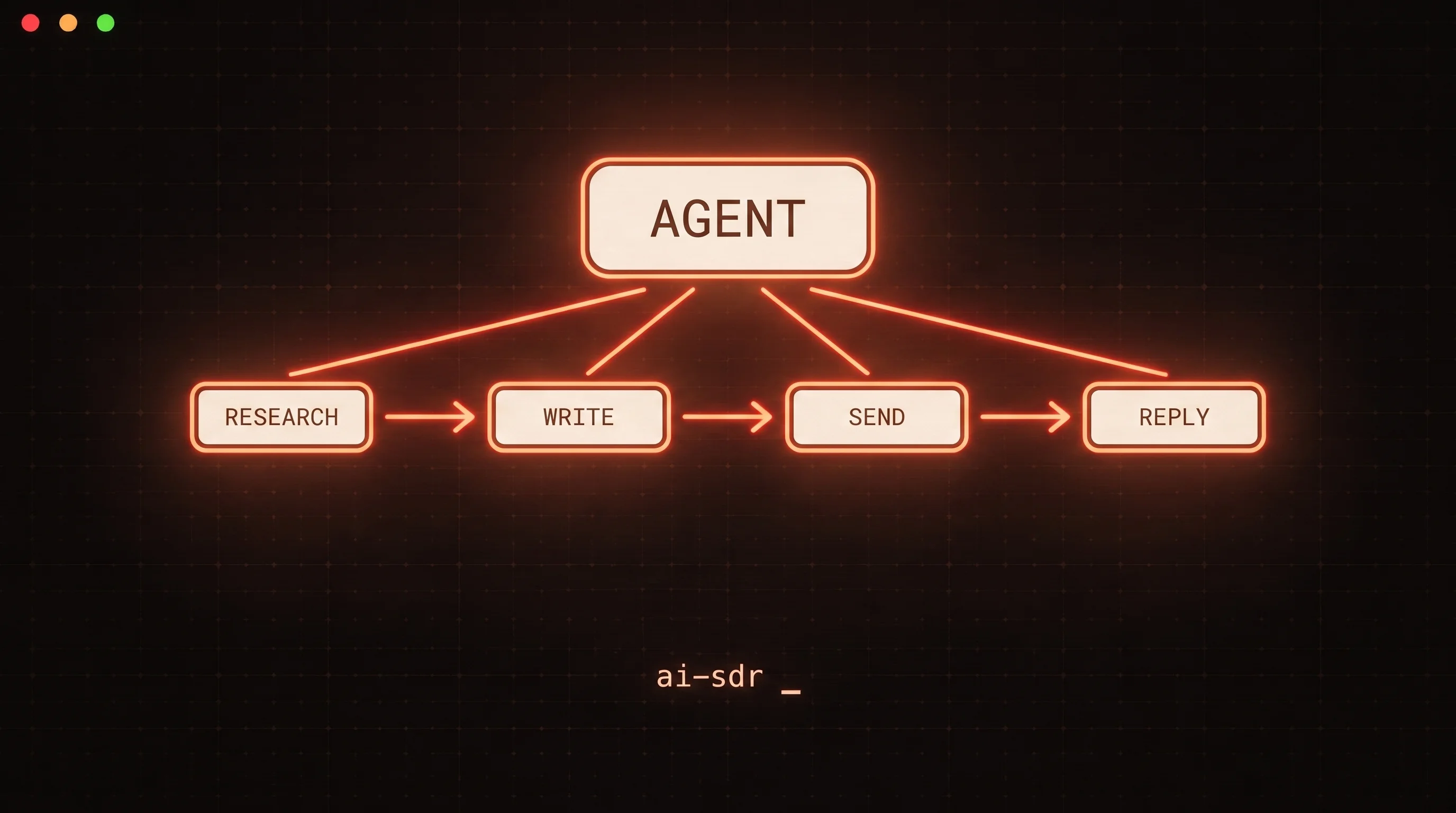
Mechanically, an AI SDR is three or four agents chained together, each specialized:
- Researcher. Takes a lead record and fetches context. Runs web searches, reads LinkedIn, hits a CRM, aggregates into a structured research note. Typically a smaller cheaper model (GPT-4o-mini, Claude Haiku) because the output is compressed.
- Copywriter. Takes the research note and a base template or brief, writes the personalized email. Bigger model (GPT-4o, Claude Sonnet) - tone matters more than facts here.
- Sender. Calls the cold email backend - create campaign, add sequence steps, import lead. Small model because this is mostly tool-calling. This is where FoxReach plugs in.
- Triager (optional). Runs on webhook triggers when replies come in. Classifies intent, drafts a response or flags for human, and updates the lead record. Small model, narrow prompt.
The agents are usually coordinated by a framework - LangChain, CrewAI, LangGraph, OpenAI Agents SDK, or a direct Python orchestrator. The coordination is less important than the four agent definitions. Any of those frameworks can run this stack.
Why 2026 and not 2023
Three things changed between the "AI SDR" pitch era (2023) and production-usable AI SDRs (2026):
LLMs got reliable at the email-writing job. GPT-4 class models (2023) could write one good cold email per 10 tries. Current models (GPT-4o, Claude Sonnet 4) write a B-minus cold email on the first try, consistently, given adequate research. That "adequate research" part is load-bearing - the copywriter is only as good as its research input.
MCP standardized agent-tool integration. Before the Model Context Protocol (late 2024 → 2026 maturity), wiring an agent to a cold email platform meant writing custom tool wrappers per framework per platform. Now a hosted MCP server exposes 61 tools to Claude Desktop, Cursor, LangChain, CrewAI, and every other MCP client in one config line.
The cold email platforms finally shipped agent-native surfaces. Until late 2025, every major cold email platform (Instantly, Smartlead, Lemlist, Apollo) was a UI-first product with an API as an afterthought. FoxReach shipped MCP + Python SDK + TypeScript SDK + CLI + Claude Code plugin as first-class surfaces. Competitors are catching up in 2026, but most are thin wrappers over their existing REST API.
What AI SDRs are actually good at
Lead sourcing at scale. A research agent can triage 10,000 LinkedIn profiles against an ICP definition in an hour, cheaper than a human SDR does it in a month. Quality is lower than a senior SDR's judgment but higher than a junior SDR's.
Personalization at scale. The old tradeoff was personalization OR volume. An AI SDR does 500 personalized emails a day where a human does 30. The personalization is shallower - one observation, not a paragraph of research - but it clears the bar of "this doesn't read like a list-blast."
Consistency. A human SDR is 70% effective on Monday and 40% effective on Friday. An AI SDR is 60% effective every day. For the outbound funnel that eats most noise anyway, consistency beats peak.
Follow-up cadence adherence. Human SDRs forget to follow up. The AI SDR doesn't. Cold email ROI is heavily driven by follow-up discipline - the 2nd and 3rd touches produce 50%+ of booked meetings. Agents follow up exactly on schedule.
Reply triage. Classifying inbound replies into hot / cold / unsubscribe / OOO is a text classification task. Agents are great at it.
What AI SDRs are still bad at
Closing-adjacent motion. Multi-threaded enterprise deals with three stakeholders and six meetings - humans win decisively here. Agents can't read the room.
Novel objections. A customer response outside the training distribution confuses the agent. Humans improvise.
Voice. Phone SDRs still exist for a reason. AI voice is close but not production-quality for cold dials yet.
Understanding your ICP beyond the words. You can describe your ICP in 500 words to a new human SDR and they will internalize the shape. Agents follow the explicit definition literally and miss edge cases.
Rage moments. When a prospect responds rudely or reports the email as spam, a good human SDR learns. An agent misses the signal unless you explicitly log it and feed it back.
The stack you need to build one
Four components, each with a clear job:
LLM provider. OpenAI or Anthropic. Route different agent roles to different models - cheap model for researcher and sender, stronger model for copywriter. LiteLLM can unify the interface if you want to swap providers later.
Research tool. Tavily, Serper, or Exa for web search. Clay for enrichment. Custom scraper if you have a specific source. The agent calls this as a tool during research.
Agent framework. Pick one: LangChain for tool-based flexibility, CrewAI for role-based crews, LangGraph for explicit multi-step graphs with conditional edges, OpenAI Agents SDK if you want Anthropic + OpenAI in one stack, or Claude Agent SDK for Claude-native long-context agents. All five work with FoxReach's MCP server out of the box.
Cold email backend. FoxReach. The agent calls it as a tool to create campaigns, add sequence steps, import leads, manage the unified inbox, and trigger webhooks on reply events. MCP server is the easiest integration path; the Python SDK and TypeScript SDK are the code-first alternatives.
When to hire an AI SDR and when to hire a human one
Pick an AI SDR when:
- You need volume (300+ leads per week contacted)
- Your ICP is well-defined and rules-describable
- You have existing content and messaging to lean on - the agent personalizes from a foundation, it does not invent positioning
- You will review drafts before sending for the first 2-4 weeks, then graduate to autonomous
Pick a human SDR when:
- Your deal size is high and your volume is low (enterprise, 50 named accounts)
- Your ICP is still fuzzy and needs iteration
- Your product story requires storytelling only a human with domain experience can do
- You need someone to own the booking conversation end-to-end, including calls
Most teams in 2026 run a mix - 1-2 human SDRs for named-account work and an AI SDR for the volume tier. The AI SDR covers leads that a human would not have time for anyway; the humans cover the leads that wouldn't convert to AI outreach. Net-net the team books more meetings than the human team alone did.
How to get started
The smallest possible AI SDR is a three-agent CrewAI crew talking to FoxReach, built in under an afternoon.
- Sign up for a FoxReach account on the free plan and generate an API key.
- Pick your framework - CrewAI is the fastest on-ramp if you like role-based agents, LangChain if you like tool-based ones.
- Wire up research + copywriter + sender agents. Each spoke guide above has working code.
- Seed a list of 20 leads, kick off the crew, and manually review every draft it produces.
- When the drafts are good enough to send without edits, graduate the sender agent to call
start_campaignand you have an autonomous AI SDR.
The hardest part is not the code - it is the discipline of reviewing drafts honestly. Agents that look correct to their builders still produce subtly broken copy on edge cases for weeks. Sample 5-10% of outbound every week even after you graduate to autonomous.
Why this matters for FoxReach
We built FoxReach MCP-first because the agentic version of outbound is the version we think wins. If you are reading this and you are building an AI SDR - or you are an AI SDR trying to figure out which platform will not make your agent's life harder - we want to hear from you. The MCP server is free to try on every plan including free. If your stack looks different from what we describe here, that is useful too.
The category will look different in two years. We are building for the category it is turning into, not the one it was.