Will letting an AI agent send your cold email wreck your deliverability? That is the question every technical founder types into Google right before they wire a model to a sending API, and the honest answer is: not by itself, but the way most people build it, yes. The agent is not the problem. The missing rate limiter is.
Here is the thing the vendor blogs gloss over. An AI agent sends the exact same SMTP traffic a human sender would. Same headers, same authentication, same envelope. A mailbox provider cannot tell whether a human or a model clicked send, and it does not try. So AI agent cold email deliverability is not a new category of spam filter. It is the old game with one safety removed - the human who used to sit between a bad decision and the actual send.
What autonomy actually removes
Think about how a bad send gets caught in a manual workflow. A rep pastes a list, starts sending, notices the first ten bounce, and stops. The dirty list costs them ten bounces, not ten thousand. The human is a slow, unreliable, but real circuit breaker.
An autonomous agent has no such pause. It sources a list, decides the leads look good, and sends to all of them at machine speed. If the list is scraped garbage, the agent does not feel the first ten bounces the way a person does. It executes the plan. The failure does not get smaller because a model is driving - it gets bigger, because the thing that used to make it small was a human paying attention, and you removed that human on purpose.
This is the risk nobody priced in when they sold "fully autonomous outbound." The pitch was throughput. The bill is that every deliverability mistake now scales to the size of your list before anyone notices.
The dangerous property of an autonomous sender is not that it makes worse decisions than a human. It is that it makes the same decisions faster, and deliverability damage compounds with speed.
The 2024 rules made the penalty instant
This got sharper in February 2024, when Google and Yahoo turned their long-standing "best practices" into hard requirements for bulk senders. Two numbers matter for anyone running an agent.
First, the spam complaint ceiling. Google's bulk sender guidelines require senders to keep the spam rate reported in Postmaster Tools below 0.30%, and explicitly recommend staying under 0.10% to survive the occasional spike. Yahoo's sender best practices enforce the same 0.30% line. That is not a rate you drift across over months. As an illustration, a single autonomous send of 5,000 messages to a mislabeled list that draws 20 complaints puts you at 0.40% in one action - over the line, from one decision, before your next scheduled monitoring check runs.
Second, the mechanics are now mandatory, not optional. Both providers require SPF, DKIM, and a DMARC policy of at least p=none, with the From header aligned to the authenticated domain. Both require a working one-click unsubscribe using the List-Unsubscribe-Post header defined in RFC 8058, and Yahoo requires you to honor opt-outs within two days. None of that is copy. All of it is infrastructure the agent has to get right on every send, and an agent that "decides" to skip it does not get a warning - it gets filtered.
Why prompt guardrails leak
The common fix you see is to write the rules into the agent's system prompt. "Never send more than 30 emails per inbox per day. Always check for opt-outs. Stop if bounces spike." This feels like a guardrail. It is not one.
A prompt is advice, and a model treats advice as advice. Across a long autonomous run it can forget a constraint buried 40 messages back, reinterpret "spike" when the numbers are ambiguous, or get argued out of a rule by its own chain of reasoning about why this list is the exception. The rule holds until the one run where it does not, and that run is the one that burns the domain. You cannot build a deliverability floor out of text the model is free to reinterpret.
This is the same lesson the best agent-native teams already learned about sending itself - covered in the pattern write-up on human-in-the-loop cold email: the safety layer cannot live inside the part of the system that is allowed to be creative. It has to live at the boundary.
Put the guardrails in the tool, not the prompt
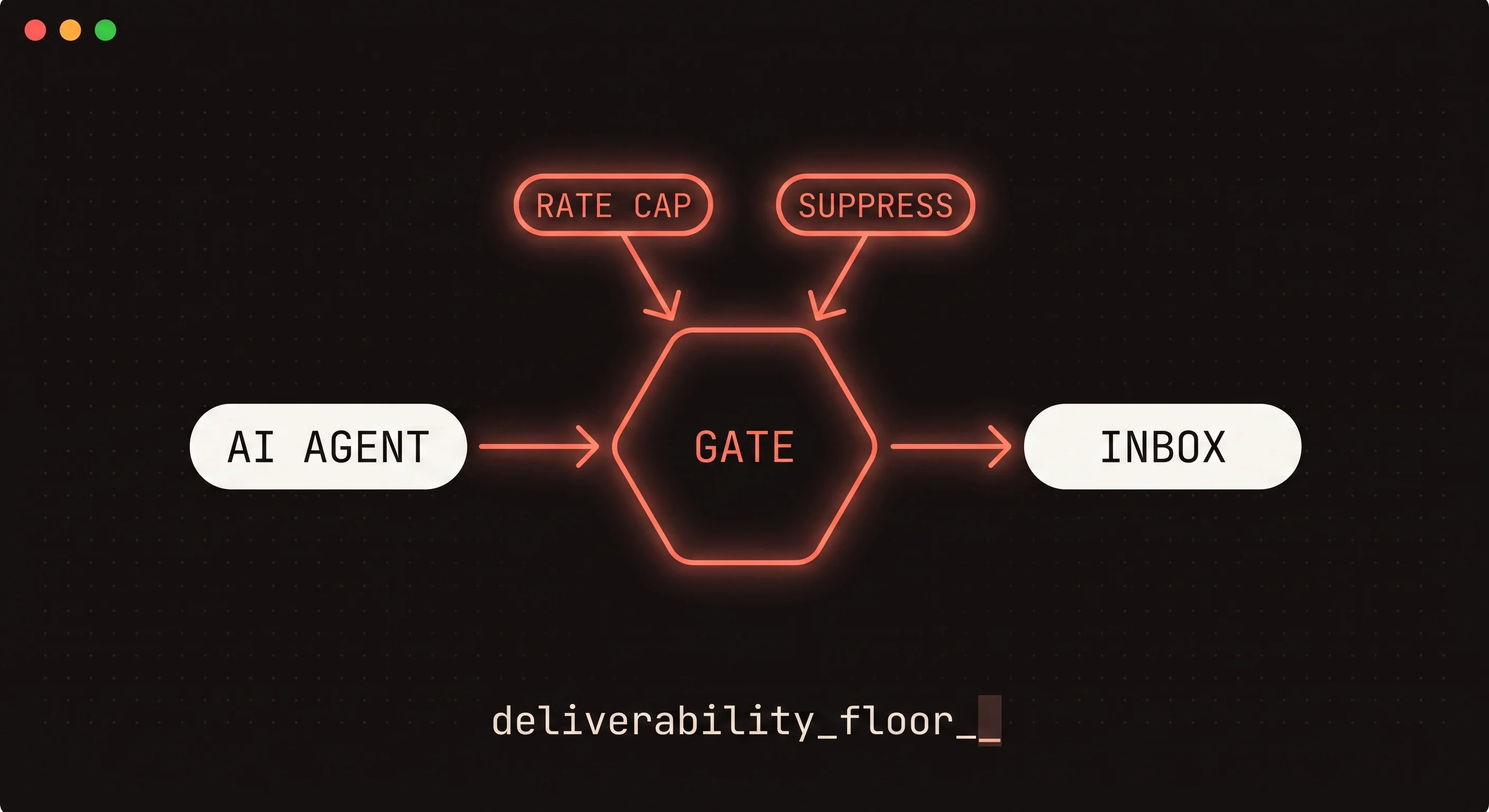
Here is the reframe that fixes AI agent cold email deliverability: the model proposes, and a typed sending API disposes. The agent is allowed to decide whom to contact and what to say. It is not allowed to decide whether the deliverability rules apply. Those get enforced by the API it has to call to actually send, so they hold on every call whether the model remembers them or not.
Concretely, five guardrails belong below the model, as behavior of the send tool rather than lines in a prompt:
- Per-domain and per-inbox rate ceilings. The API caps sends per mailbox per day and paces them across the window. The agent can request 500 sends from one inbox - the API executes the safe number and queues the rest. The cap is not negotiable because it is not the model's to negotiate.
- Suppression checked on every send. Every send call checks a suppression list first and rejects opt-outs, bounces, and prior complainers. An unsubscribe is honored because the address is rejected at the boundary, not because the model reasoned its way to honoring it.
- Bounce-triggered backoff. When the bounce rate on a domain crosses a threshold, the API throttles or pauses that domain automatically. The circuit breaker the human used to be becomes code that reacts in real time, not at the next review.
- Authentication as a precondition. The API refuses to send from a domain missing SPF, DKIM, or DMARC, so an agent cannot accidentally route through an unauthenticated domain and torch its reputation.
- One-click unsubscribe injected automatically. The required List-Unsubscribe headers are added by the sending layer on every message, so compliance does not depend on the agent remembering to format them.
Notice what this does. It lets the agent stay fully autonomous on the decisions that need judgment - targeting, timing, messaging - while the decisions that need a hard floor are simply not available to it. That is not a limit on the agent. It is what makes it safe to let the agent run without a person watching every send. The same idea drives autonomous reply triage: give the model room where judgment helps, and a typed boundary where mistakes are expensive.
If you are building the foundation under all of this, the general mechanics still apply - warmup, sending patterns, authentication - and the complete guide to cold email deliverability covers them. What changes with an agent in the loop is only where the rules are enforced.
What to measure once the floor is in place
Guardrails at the boundary do not remove the need to watch. They change what you watch for. Instead of eyeballing individual sends, you monitor the aggregates that predict a filtering event, and you let the API act on them faster than you can:
- Spam complaint rate per domain, held well under the 0.30% line with the 0.10% target as your real ceiling.
- Bounce rate per domain, with automatic backoff wired to it rather than a human deciding when to pause.
- Suppression hit rate, which tells you how dirty your agent's sourcing is before the complaints do.
- Authentication pass rate, because a DKIM key that silently breaks looks fine until placement collapses.
The point of moving guardrails into the tool is that these numbers stop being a post-mortem and start being a control loop. The API sees the bounce rate climb and slows down in the same minute, not the same week.
Your next step
Do not start by rewriting your agent's prompt with more rules. Start by moving one rule below the model. Pick the guardrail with the widest blast radius - a per-inbox daily send cap - and enforce it in the API your agent calls, not in the text it reads, so the ceiling holds on the run where the model would have ignored it. The fastest way to get there is to have your agent send through the FoxReach MCP server, where the rate limits, suppression checks, bounce backoff, and authentication live in the send boundary itself, and read the overview of cold email built for AI agents to see how the sourcing, sending, and reply stages connect around that boundary. Wire that one cap this week, watch your per-domain complaint rate hold under 0.10%, and you have turned the risk nobody priced in into a limit the model cannot cross.