You have set up five sending inboxes for your AI SDR. Each one warmed for three weeks, DMARC and DKIM on every domain, rotation enabled in your campaign settings. Monday morning you pull the logs: 380 of the day's 400 sends went through inbox one. Inboxes two through five handled 20 between them. Your primary inbox is sitting at eight times its warming baseline - and it ran that load before you checked Slack.
This is the failure mode cold email inbox rotation is supposed to prevent. What most of the documentation written for human-operated sequences does not address is how much more likely it becomes when an agent is doing the sending, and why the fix is architectural rather than a matter of getting the rotation setting right.
What cold email inbox rotation actually does
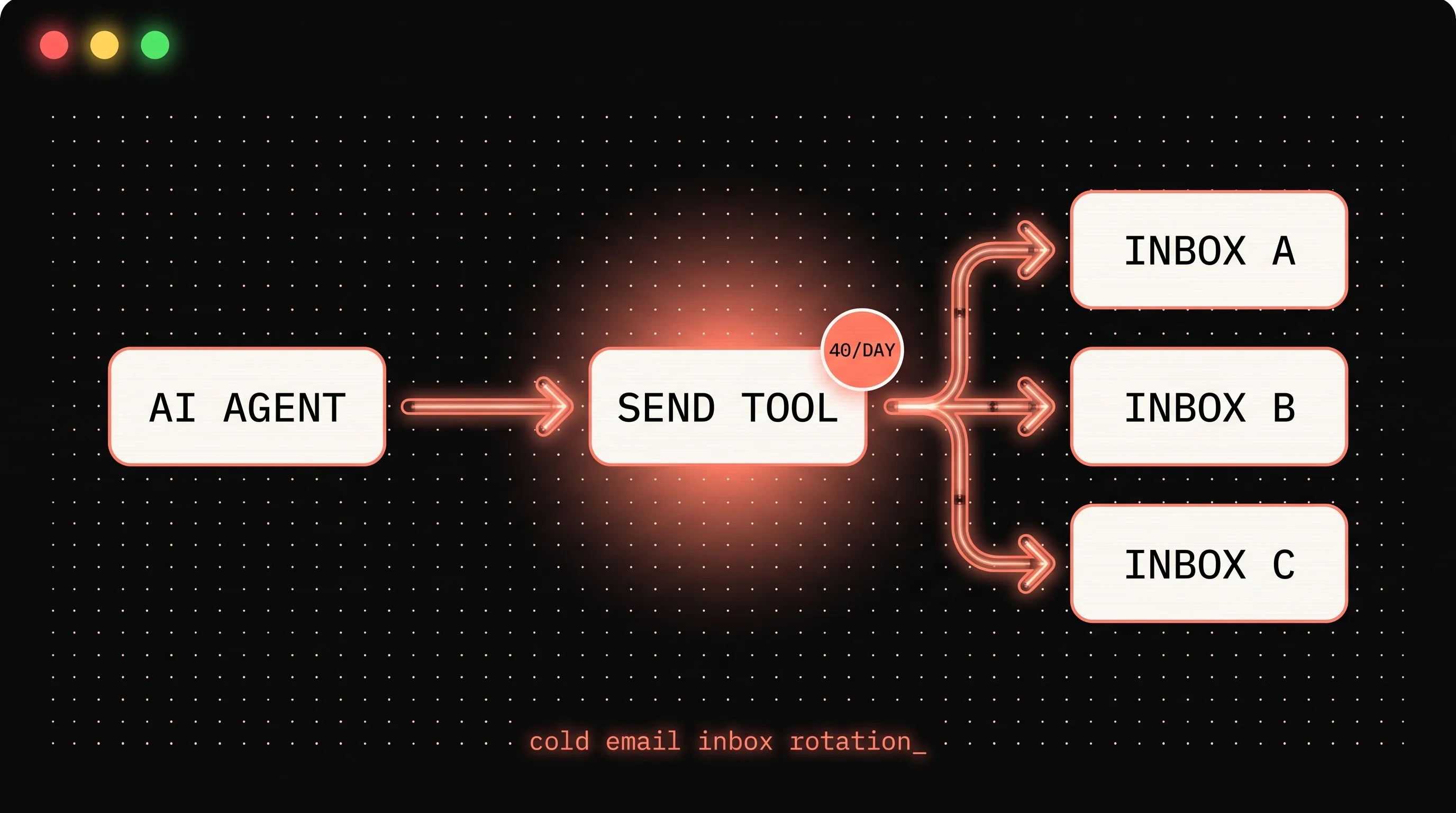
Cold email inbox rotation distributes outbound sends across multiple sending addresses instead of routing everything through one inbox. The purpose is volume safety: every sending inbox has a daily ceiling it can operate within without triggering spam classification, and rotation lets you scale total volume by spreading load rather than overloading a single account.
That ceiling is not arbitrary. A mailbox provider evaluates sending reputation per domain and per IP. A warmed inbox that sends 40 messages per day, every day, for three months builds a coherent history the provider can evaluate positively. A new inbox that fires 200 emails a day looks like a compromised account or an unwarmed bulk sender - exactly the pattern spam filters are tuned to catch. Rotation lets you reach higher total volume by adding inboxes with stable histories rather than pushing one inbox past what its history supports.
As a rough operational rule, most senders set the daily limit between 30 and 50 sends per inbox for a fully warmed account. Unify's 2026 cold email infrastructure guide gives a concrete ramp: 5 to 10 sends per day in weeks one and two, stepping to 10 to 20 in week three, then 25 to 65 in week four and beyond as engagement data accumulates. The 65 figure is the ceiling Unify documents when metrics support it; many teams run lower as a conservative default. New inboxes carry the warmup risk - push the ramp faster than the data supports and the platform's signals start looking like bulk-sender behavior before the inbox has earned a history to back it up.
What rotation does not do: it does not fix authentication gaps, rescue a domain with a burned reputation, or substitute for proper DMARC, DKIM, and SPF setup. Those are preconditions - see AI agent cold email deliverability for the authentication layer that has to come first. Rotation is what you build on top once that foundation is solid.
Why agents break rotation in ways human senders do not
A human operator running a sequence in a traditional tool has a natural check on volume that precedes any configuration: attention. They start a campaign, watch the first batch go out, and have some sense of what went where. When something breaks - an inbox spiking past its limit, a bounce rate climbing - the human eventually notices and stops.
An agent has no such loop. It has a decision process and a tool call, and it will execute that tool call as many times as the queue demands until something in the infrastructure stops it.
Here is the specific failure shape in practice. An AI SDR is given a batch of 400 qualified leads and a send tool. The sending layer has rotation configured, but the rotation is implemented as a campaign preference - something the platform interprets when building the outbound queue. The agent calls send once per lead. The campaign tool processes the queue quickly and, depending on whether the platform uses round-robin or priority order, may route most of the batch through the first available inbox before the per-inbox counter for the others is checked.
The result is what appeared in Monday's logs: one inbox handling 380 sends, four inboxes sitting idle, and a domain reputation that just absorbed a volume spike it was not built to handle.
This is not a misconfiguration. It is a design question about where the routing decision and the limit enforcement actually live.
The dangerous property of an autonomous sender is not that it makes worse decisions than a human about rotation. It is that it executes faster, and a wrong routing decision at machine speed looks like a deliverability incident before anyone can intervene.
Round-robin versus priority order
Rotation platforms typically offer two routing modes. Round-robin distributes sends evenly across inboxes in sequence: send one goes to inbox A, send two to inbox B, send three to inbox C, then cycles back to A. Priority order sends through inbox A until its daily limit is hit, then switches to inbox B, and continues down the list.
Priority order is the wrong default for AI-driven outbound. A human campaign might send 10 emails in the morning and 40 in the afternoon, naturally spreading load across hours in a pattern that looks organic to mailbox providers. An agent executing a 400-lead batch at 2 AM hits inbox A's 50-send limit in one run, switches to inbox B, exhausts that, and continues down the priority list - giving each inbox a full day's volume in a single execution rather than distributing it across business hours. The inboxes are not exceeding their daily limits, but they are absorbing them in a compressed window that looks nothing like a normal sending pattern.
Round-robin distributes differently. It routes across all inboxes within any single agent run rather than exhausting one before moving to the next. That does not fully solve the timing problem - a large batch still compresses sends into a short window - but it prevents any single inbox from absorbing all the volume while the others sit idle.
The more important question, though, is not which rotation mode the platform offers. It is whether the daily ceiling is enforced in the platform's configuration settings - a preference the sending tool interprets - or in the tool call itself, which cannot be bypassed regardless of how the agent decides to sequence its work.
The math: how many inboxes you actually need
The arithmetic is straightforward once you fix the daily ceiling.
If your target is 500 sends per day and your per-inbox limit is 40, you need at minimum 13 inboxes. As a practical planning rule, add around 20% headroom for warm-up variance and rotation dynamics - that rounds to roughly 16. Each inbox needs its own domain - never send cold from your primary company domain - and its own three to four week warm-up period before it carries meaningful production volume.
That warm-up runway is a real constraint. Following Unify's documented ramp of 5 to 10 sends per day in the first two weeks stepping to 25 or more in week four, a new inbox is building its history before it can contribute production volume. Scaling from 200 sends per day to 1,000 means adding roughly 20 inboxes, each with a multi-week lead time before they are ready.
The practical implication: cold email inbox rotation is not a setting you enable before a large send. It is infrastructure you build weeks ahead of the volume you intend to reach. An autonomous AI SDR can decide to send to 500 new prospects in a single agent run; that decision does not pause while your inbox count catches up. The gap between what the agent can attempt and what the infrastructure can safely absorb is the operational risk - and it widens faster when the sender does not hesitate the way a human would.
Where enforcement has to live
The same principle that applies to preventing duplicate cold emails and verifying addresses before send applies to rotation: the limit has to live in the tool, not the prompt.
A prompt instruction that says "rotate evenly across inboxes and respect the 40 per day ceiling per inbox" is advisory. A model can follow it faithfully on every normal run and still exceed it the first time an unusual batch size or a retry loop pushes the execution into territory the instruction did not account for. Advisory rules governing irreversible actions - sends already delivered, domain reputation already damaged - are the wrong layer for enforcement.
A tool call that checks the current send count for each inbox before routing, returns an error if the ceiling would be exceeded, and forces the agent to select a different inbox or halt, is a constraint. It holds regardless of the prompt, the batch size, the time of day, or what the agent decided upstream. Google's email sender guidelines set the spam complaint ceiling at 0.10% as a target and 0.30% as a hard limit for bulk senders. The infrastructure implication follows directly: enforcement has to prevent violations before they happen, not rely on the good intentions of whoever configured the campaign.
For autonomous senders, that means the per-inbox counter and the routing logic need to live inside the send layer the agent calls as a tool - specifically, inside FoxReach's cold email MCP server - not in a campaign configuration a human reviews once when setting up. The agent that calls send_email and gets back a routing error because inbox three is at its daily ceiling will never push that inbox past its limit. Exceeding it would require a code path that does not exist. The routing decision and the limit check happen at the same point, on every call, regardless of agent version, batch size, or retry logic upstream.
This is the read on cold email infrastructure for AI agents that most guides miss. Rotation is not a feature you configure on top of a sequencer and trust the agent to respect. It is a constraint enforcement question that has to be answered at the layer the agent actually touches - and the answer has to hold even when the agent is running an overnight batch you did not plan for.
Start here
Check whether your current setup enforces the per-inbox daily ceiling at the tool call level or in a configuration setting. Pull your send logs from the last large batch and verify that inbox send counts are genuinely capped at runtime. If the limit is controlled by a campaign setting the agent can route around during overnight or large-batch runs, the ceiling is advisory - and an autonomous sender will eventually demonstrate that distinction.
Wire your agent's send action to FoxReach's cold email MCP server and the routing and per-inbox enforcement happen at the tool call layer. Your agent gets the routing error before an inbox limit is exceeded, not after the morning logs tell you it already happened.