It is a Friday night. Your new AI SDR has been running autonomously for a week and the numbers look great, so nobody is watching. At 2am it enriches a list, decides a batch of 400 contacts look promising, and sends. Three of those contacts work at a company that is already a paying customer mid-renewal. One is a lead the account team has been nurturing for two months. Forty are on a domain you burned last quarter and swore you would never touch again. The agent did exactly what it was told - source, personalize, send - and every one of those sends was a mistake no line of its prompt forbade.
This is the failure mode that turns teams off autonomous outbound, and it is almost never a model-quality problem. The copy was fine. The targeting logic was reasonable. What was missing was the layer that says no when the agent is about to do something it should not, regardless of how confident the model was. That layer is what AI SDR guardrails are, and building them is a different job from building the agent itself.
What AI SDR guardrails actually are
The word "guardrails" gets used loosely, usually to mean "we told the model to be careful." That is not a guardrail. AI SDR guardrails are the controls that constrain what an autonomous outbound agent is allowed to do, enforced in the tools the agent calls rather than in the instructions it reads.
The distinction matters more here than in almost any other agent application, because a cold email send is irreversible and externally visible. You cannot un-send a message. You cannot un-burn a domain. When the payload of a tool call is an email leaving your domain and landing in a stranger's inbox, the cost of a single wrong decision is not a wasted API request - it is a damaged relationship, a filtering event, or a compliance violation. If you are still assembling the stack itself, how to build an AI SDR walks through the pieces; this post is about the controls you wrap around them before you let go of the wheel.
A rule written in the prompt is a suggestion. A rule written in the tool the agent calls is a limit. Guardrails are the second kind.
Here is why that line is not pedantic. A model can misread an instruction, drift from it over a long run, or be pulled off it by an unusual input - and you will not find out until the sends have happened. The OpenAI Agents SDK makes the pattern explicit with tool guardrails and tripwires: validation code runs around a tool call, and can skip the call, replace its output, or halt the agent entirely the moment a rule is broken. That is the shape every guardrail below takes - not a paragraph in a system prompt, but code at the action boundary that the model cannot argue with.
The five guardrails
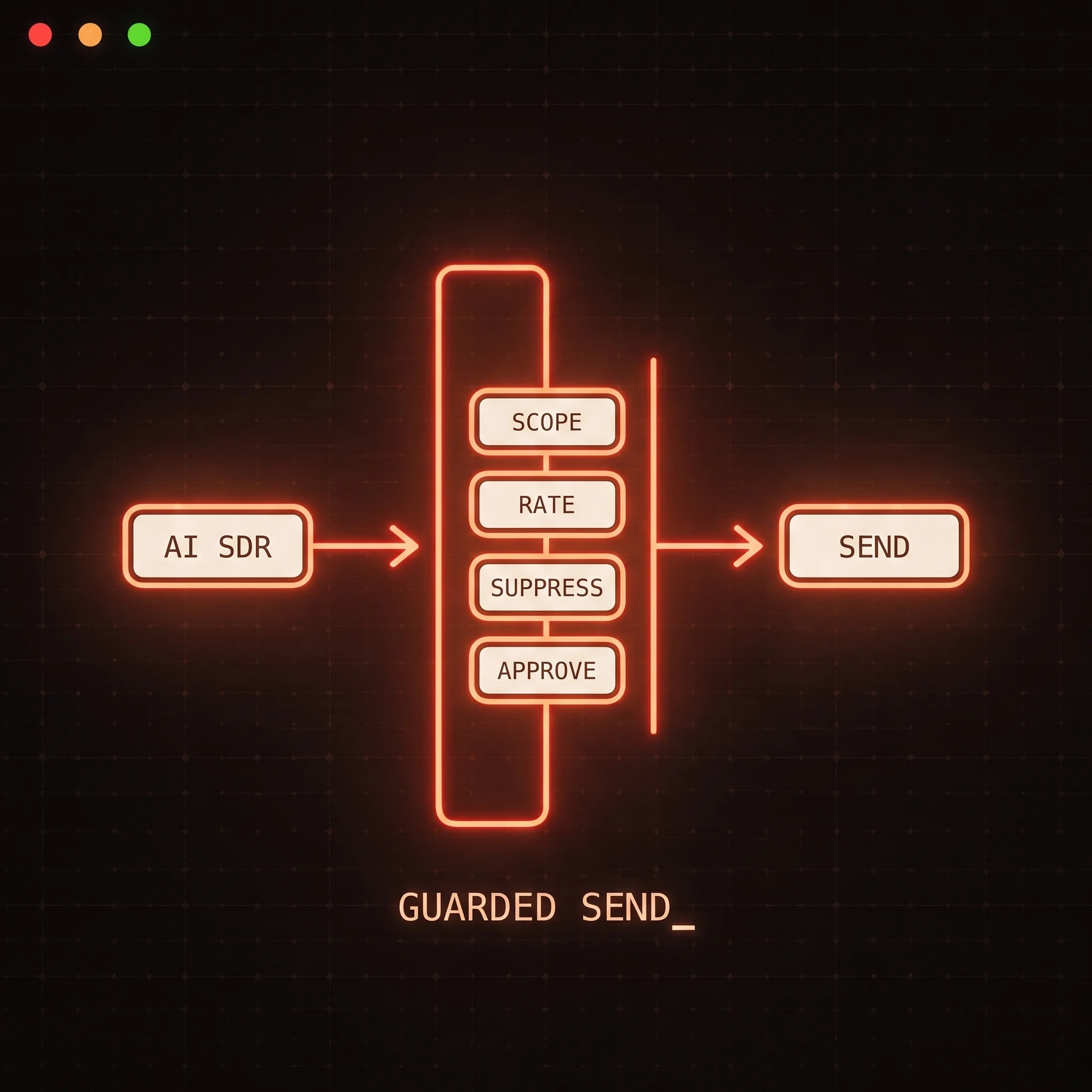
Think of an AI SDR's freedom as a set of permissions you grant one at a time, not a single on/off switch. There are five controls worth building, in rough order of how much damage each one prevents.
1. Scope - what the agent can touch
Scope defines the actions and data the agent has access to at all. A read-only enrichment agent that cannot call the send tool has a blast radius of zero. Most teams over-grant here by default, wiring the agent to the full API and hoping the prompt keeps it in bounds.
Do the opposite. Give the agent the narrowest set of tools that lets it do its job, and scope the data each tool can reach - this campaign's lists, not every list in the account; these verified domains, not any address it can invent. In practice that looks like an access token bound to specific list IDs and a send tool that rejects any recipient outside them, so a hallucinated address has nowhere to go. Scope is the guardrail you set once at wiring time and rarely think about again, which is exactly why it is the cheapest one to get right.
2. Rate - how fast it can send
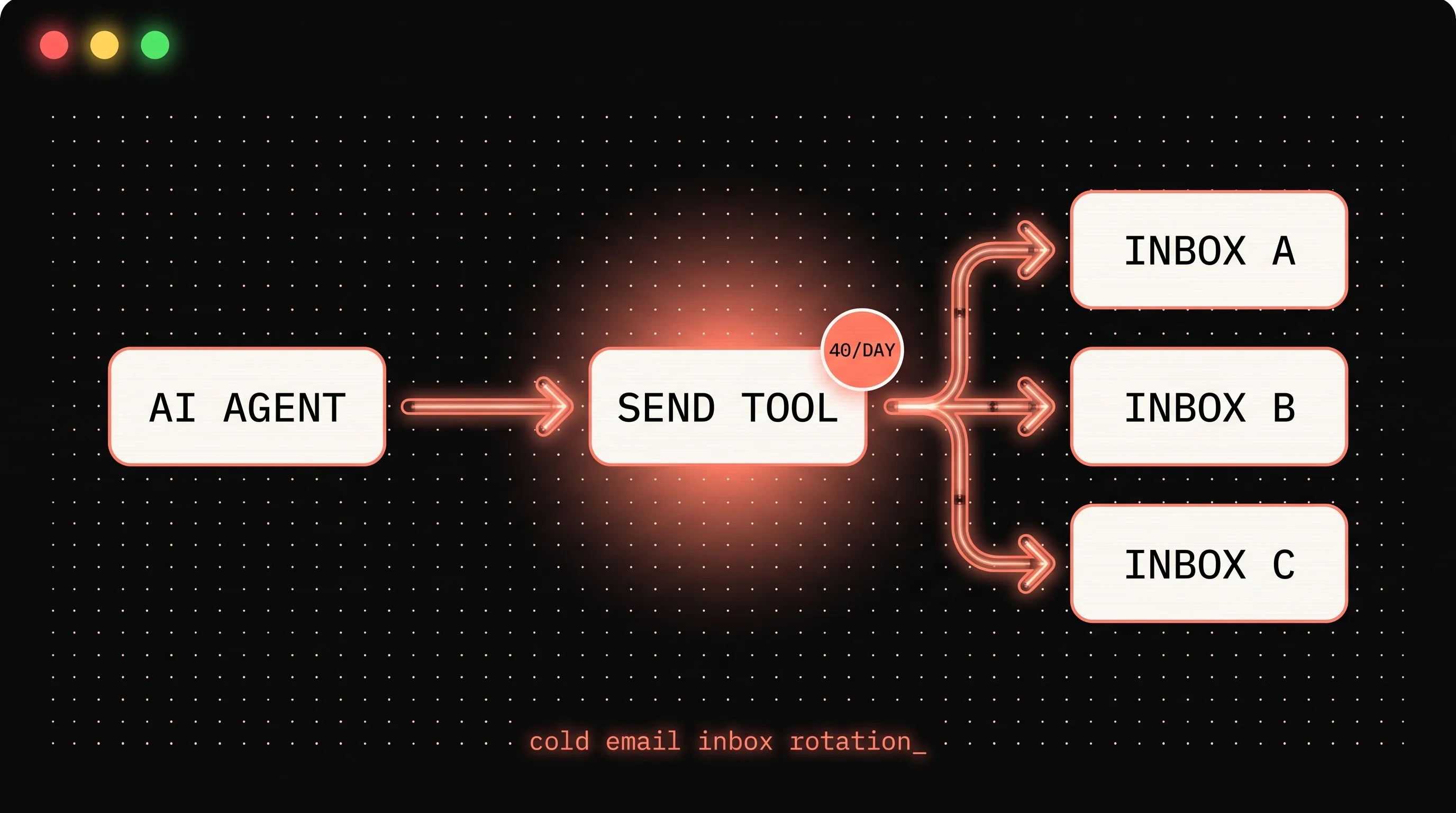
Rate limits cap how many sends happen per inbox, per domain, and per unit of time. This is the guardrail with the widest blast radius, because volume is what mailbox providers watch. An agent that sends the same SMTP traffic a human would is invisible to spam filters until it sends too much of it too fast from one domain - then placement collapses for every campaign on that domain, not just the one that misbehaved.
The mistake is putting the daily cap in the prompt. The fix is enforcing it in the send tool so the ceiling holds on the run where the model would have ignored it. We treated this one on its own in AI agent cold email deliverability, because it is the single guardrail most likely to save a domain - the short version is that a per-inbox daily cap belongs in the API the agent calls, with automatic backoff wired to bounce and complaint rates rather than a human deciding when to pause.
3. Suppression - who it must never contact
Suppression is a hard block list the agent cannot send through no matter what it decides: unsubscribes, prior opt-outs, do-not-contact flags, and - the one autonomous agents get wrong most often - existing customers and accounts another team already owns. The classic autonomous failure is an agent that cannot see a regional branch is owned by a customer spending millions a year, so it fires a generic cold sequence at them.
Suppression is also where compliance stops being optional. Under the FTC's CAN-SPAM rules, you must honor an opt-out promptly, and each violating message can draw a civil penalty that the FTC adjusts for inflation every year - a five-figure sum per email at current levels. In the EU, Article 83 of the GDPR caps fines for unlawful processing at the greater of 20 million euros or 4% of global annual turnover. An agent that sends to a suppressed address is not just rude - it is a fine with a send button. The guardrail is a suppression check inside the send tool that runs on every recipient, so a dirty enrichment step cannot leak a forbidden address into a live send.
4. Approval - the sends a human still owns
Approval is the human-in-the-loop gate: the agent pauses on a defined slice of high-risk sends, surfaces the drafted message and its reasoning, and waits for an approve, edit, or reject before continuing. The trick is gating the right slice. Approve every message and you have rebuilt manual outreach and thrown away the point of the agent. Approve nothing and you have no judgment on the sends where judgment matters.
The pattern that scales is exception-based - the agent runs freely on the bulk and pauses only on the small set that trips a rule: a first touch to a top-tier account, a reply from an interested prospect, a low-confidence match, an unusual instruction. Human-in-the-loop cold email covers where to place that gate and which decisions are worth a human's attention. As a guardrail, its job is narrow: catch the expensive-to-reverse sends the other four controls cannot reason about.
5. Kill switch and audit log - halt and answer for it
The last guardrail assumes the other four will eventually miss something, because they will. You need one command that stops all sending immediately - not "update the prompt and redeploy," but a switch that pauses every agent's send tool in the same minute you notice a problem. And you need a log of every action the agent took: what it sent, to whom, why, and which guardrails it passed on the way.
The audit log is not bureaucracy. It is how you answer a GDPR data-subject request that asks what an automated system did with someone's data, and it is how you find the root cause after a bad run instead of guessing. An autonomous system without an audit trail is one where you cannot prove what happened - which, when the actor is a model making its own calls, is a position you never want to be in.
Where the guardrails belong
Notice what every one of these has in common: none of them live in the model. Scope, rate, suppression, approval, and the kill switch are all enforced at the action boundary - the send tool the agent calls - not in the reasoning that leads up to it. That is deliberate. Guardrails enforced inside the model protect you only as long as the model behaves. Guardrails enforced in the tool protect you no matter which agent, framework, or protocol made the call.
This is the case for putting the send behind a governed tool rather than raw SMTP credentials. When outreach actions are exposed through a cold email MCP server, the rate limits, suppression checks, approval gates, and audit logging live in the boundary itself - so the guardrails hold whether the caller is a Claude agent, a LangChain script, or a cron job, and you enforce them once instead of re-implementing them in every agent you ship. The overview of cold email built for AI agents shows how sourcing, sending, and reply handling all connect around that guarded boundary.
How to know your guardrails actually work
The guardrail nobody tests is the guardrail that fails at 2am. Most teams write the rules and assume they hold. Treat them like any other safety-critical code and try to break them on purpose:
- Scope: ask the agent to touch a list or domain outside its grant and confirm the tool refuses, not the prompt.
- Rate: script a run that tries to exceed the per-inbox cap and confirm the send tool rejects the overflow rather than slowing politely.
- Suppression: seed a known opt-out and a known existing-customer address into the agent's input and confirm neither one gets a send.
- Approval: feed it a send that should trip the gate and confirm it pauses instead of firing.
- Kill switch: flip it mid-run and confirm sending stops within the minute.
If any of those checks passes through when it should have blocked, the rule was living in the prompt, not the tool. Move it down and test again.
The takeaways
AI SDR guardrails are the difference between an autonomous sender you can trust and one you have to babysit - and the whole discipline comes down to a few rules:
- A guardrail lives in the tool, not the prompt. If the model can ignore it, it is not a guardrail.
- Build five controls, not one. Scope limits what the agent touches, rate limits how fast it sends, suppression blocks who it must never contact, approval gates the sends a human owns, and a kill switch plus audit log let you halt and answer for everything.
- Start with rate. It has the widest blast radius and protects the one asset - your sending domains - that is hardest to recover.
- Enforce at the action boundary. Put the controls in the send tool so they hold no matter which agent or framework calls it.
- Test them adversarially. A guardrail you have never tried to break is a guess.
Do not start by rewriting your agent with more rules. Start by moving one rule below the model. Pick the guardrail with the widest blast radius - the per-inbox send cap - and enforce it in the tool your agent calls, which is exactly what the FoxReach MCP server is built to do. Wire that one control this week, try to break it, and you have turned an autonomous sender from a liability into a system that fails safe.