The instinct when you build an AI SDR is to remove the human completely. Full autonomy sounds like the finish line: the agent sources, writes, sends, and never bothers you. That instinct is wrong, and the teams shipping the best agent-native outbound in 2026 know it. The goal was never zero humans. The goal is to spend human attention only where it changes the outcome, and let the agent have everything else.
That is what human-in-the-loop cold email means in practice. Not a person babysitting every message, and not a black box firing into inboxes unsupervised, but a system that runs on its own until it hits a decision worth a human, then pauses and asks. Get the boundary right and you keep the throughput of automation with the judgment of a person on the few sends where judgment matters. Get it wrong in either direction and you either rebuild manual outreach or ship embarrassing mistakes at machine speed.
What human-in-the-loop cold email means
Every outbound stack sits somewhere on an autonomy spectrum:
- Fully manual. A person writes, reviews, and sends every message. Highest quality per message, but it caps out at a few dozen thoughtful sends a day.
- Human-in-the-loop. An agent does the volume work and a person approves or corrects the decisions that carry risk. High throughput, with a human on the expensive calls.
- Fully autonomous. The agent sends with no review. Maximum throughput, but a single bad pattern - a broken merge field, a hallucinated claim, a misread reply - repeats across every send before anyone notices.
Human-in-the-loop is the middle band, and it is where most serious cold email should live. Even Anthropic's own guidance on building effective agents frames autonomy this way: agents should "pause for human feedback at checkpoints or when encountering blockers," and run with "stopping conditions" and guardrails rather than open-ended freedom. Cold email is a textbook case, because the cost of a mistake is asymmetric. A great automated send earns you a reply. A bad automated send at scale burns domain reputation, annoys real buyers, and is nearly impossible to recall.
The mistake: gating everything
The most common way to get human-in-the-loop wrong is to gate too much. A team wires up an agent, gets nervous, and routes every single message to an approval queue. Now a person is reading 300 drafts a day, rubber-stamping most of them, and the agent has bought them nothing except a slower version of manual outreach. Within a week the reviewer is approving in bulk without really reading, which is worse than no gate at all because it looks like oversight while providing none.
The fix is to accept a simple division of labor: automate the mechanical, gate the relational.
| Decision | Default | Why |
|---|---|---|
| Lead sourcing and enrichment | Automate | Cheap to redo, easy to spot-check in aggregate |
| Drafting copy | Automate | The draft is a proposal, not a send |
| Follow-up scheduling | Automate | Deterministic rules, low downside |
| Archiving noise (auto-replies, bounces) | Automate | No human judgment adds value |
| Honoring an opt-out | Automate | Must be instant; see compliance below |
| First touch to a top-tier account | Gate | One shot at a named, high-value buyer |
| Reply to an interested prospect | Gate | A clumsy auto-reply burns a real opportunity |
| A send the model flagged low-confidence | Gate | The system is telling you it is unsure |
Notice that the gated rows are a small fraction of total volume. That is the whole design target. If your gate is catching most of your sends, your rule is too broad.
Tip: measure your gate rate. As a rough starting point, if a person is approving more than 10-15% of sends, tighten the rule until the queue holds only genuinely risky items. A gate that catches everything is a gate nobody reads.
Four patterns that work
There is no single correct architecture. These four cover most real setups, and you can combine them.
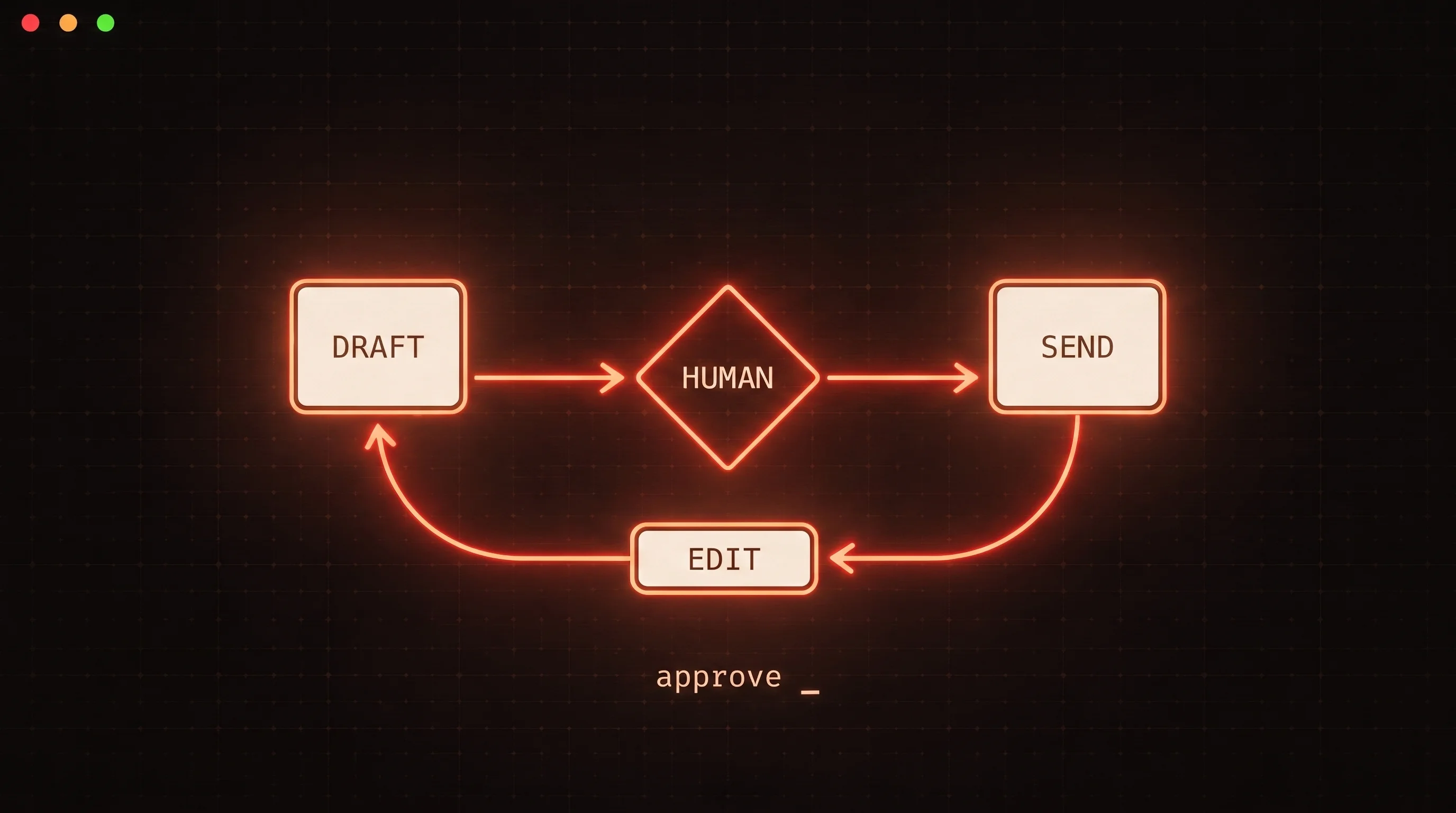
1. Approve-to-send queue. The agent drafts everything and drops each message into a review queue. A human scans, edits inline where needed, and approves. This is the right starting point when you are new to a model or a campaign and do not yet trust the copy. It is also the pattern most quick tutorials describe. Its weakness is that it does not scale - so treat it as a phase, not a destination. You run approve-to-send until the drafts are consistently good, then graduate to something lighter.
2. Tiered autonomy. Match oversight to stakes. Tier 1 accounts (named, high-value, strategic) stay human-approved. Tier 2 (scaled personalization) is agent-drafted with light review. Tier 3 (programmatic, high-volume) runs fully automatic under strict guardrails. The same agent runs all three; only the gate rule changes per tier. This is how you keep a human on the accounts where a personal touch closes deals without dragging that overhead across your entire list.
3. Sample-and-audit. The agent sends autonomously, but a human reviews a random 5-10% of outbound every week after the fact. You are not gating sends - you are gating your trust in the agent. When the sample shows the copy drifting or a merge field breaking, you catch it early and tighten the prompt. This is the pattern that lets you stay autonomous safely, because in practice an agent that looks correct to its builder will still produce subtly broken copy on edge cases long after you stopped watching.
4. Exception-based escalation. The agent runs freely and pauses only when it trips a condition: model confidence below a threshold, an account above a value line, a reply it cannot cleanly classify, or an instruction it has never seen. This is the most scalable pattern and the one that best matches how the autonomous reply triage side of the stack already works - cheap model handles the clear cases, humans see only the ambiguous ones. The agent's own uncertainty becomes the routing signal.
Most mature stacks end up blending patterns 2 and 4: tiered by account value, with an exception rule layered on top so even Tier 3 escalates when the model is unsure.
The gate belongs at the action boundary
Where in the agent's loop should the human sit? At the action boundary - the exact moment the agent is about to do something the outside world can see. For cold email, that boundary is the send.
Let the agent think, research, draft, and revise as freely as it wants up to that line. Interrupting a model mid-reasoning to ask "are you sure?" produces worse output and slower humans. But when the agent reaches a send that matches your gate rule, it should stop, surface the finished draft along with the reasoning that produced it, and wait for one of three answers: approve, edit, or reject. This maps to the standard agent interrupt patterns - approve or reject an action, or edit the proposed action before it runs - that agent frameworks now build in as a first-class primitive.
Gating at the action boundary rather than inside the reasoning keeps two things intact: the agent stays useful because you did not lobotomize its thinking, and the human stays focused because they review a concrete artifact (a real drafted email) instead of a half-formed plan.
Compliance is the one place the machine wins
There is one category where the human should get out of the way entirely: opt-outs. When someone asks to be removed, speed is a legal and deliverability requirement, and a human in the loop only adds dangerous latency.
The rules are specific. Under the FTC's CAN-SPAM compliance guide, you must honor an opt-out within 10 business days, and your opt-out mechanism has to keep working for at least 30 days after you send. Separately, Google's email sender guidelines require one-click unsubscribe and a visible unsubscribe link for anyone sending more than 5,000 messages a day to Gmail. None of that benefits from human review. An agent should detect opt-out intent, suppress the contact everywhere it sends, and log it - instantly, automatically, every time.
Warning: an opt-out sitting in a human approval queue is the worst of both worlds. You get the latency of manual review and the compliance risk of a delayed suppression. Automate this one without exception.
So the boundary is not "humans handle the sensitive stuff." It is sharper than that: humans handle the judgment calls, machines handle the rule calls. Opt-out is a rule. A first-touch to your dream account is a judgment. Route each accordingly.
Building the gate as an agent tool
For any of this to work, the approval step has to be a real part of the agent's toolset, not a spreadsheet a person remembers to check. The agent needs typed actions it can call: draft a message, submit it for approval, check approval status, send on approval, suppress on opt-out. When the gate is a tool the agent calls, the pause and resume happen inside the same run, and nothing falls through a manual crack.
That is the surface the FoxReach MCP server exposes. It gives an agent typed access to leads, campaigns, sends, and suppression, so the same agent that drafts a message can hold it for approval, send it once approved, and suppress an opt-out in one connected loop - no CSV export, no separate approval app, no nightly sync that drifts out of date. The human review step becomes one more state the agent understands, rather than a bolt-on process living in someone's inbox.
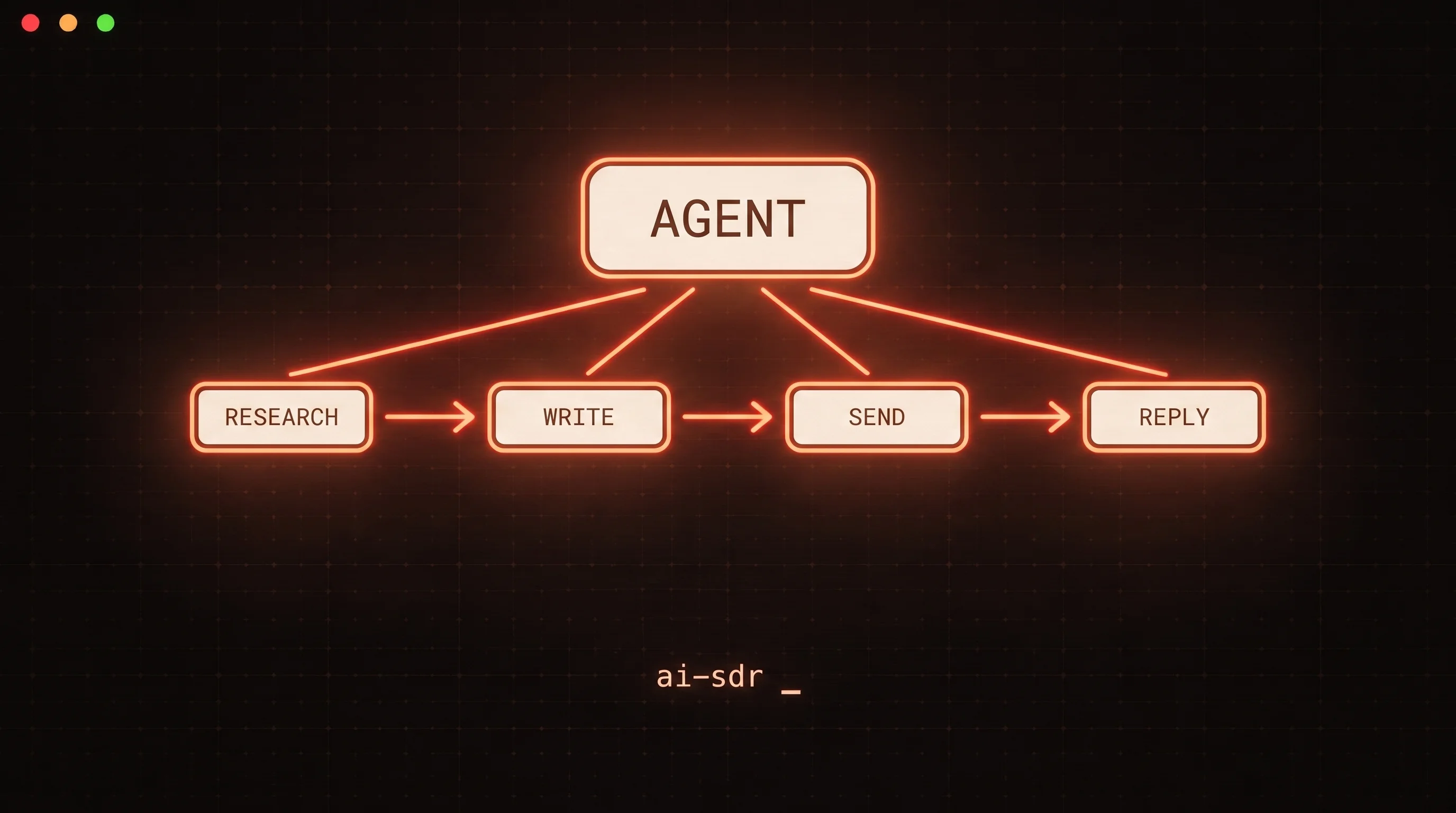
This is the core idea behind cold email built for AI agents: the agent does not just generate a judgment and hand it off, it takes the action its judgment implies, pausing for a person only at the boundary you defined. If you are still mapping out the full picture, the explainer on what an AI SDR is shows where the human-in-the-loop gate fits between sourcing, sending, and reply handling.
Your next step
Pick one gate rule and ship it this week. The highest-leverage first move is exception-based escalation on a single signal: have your agent run autonomously on everything except sends to your top-tier accounts, and route only those to a person. Wire that gate as a tool through the FoxReach MCP server so the pause lives inside the agent's own loop, not in a side process, then watch your gate rate for a week. If a person is approving almost everything, tighten the rule. If they are catching real mistakes, you found the right line - and now you can widen the agent's autonomy everywhere the gate stays quiet. That feedback loop, not full autonomy, is what a durable agent-native outbound system is actually made of.