What is the best cold email send time - and does the answer change when an AI agent is doing the sending?
Two things are true simultaneously. The cold email send time benchmarks you have seen are broadly correct, and they are much less important than the guides imply. A separate set of timing considerations - ones the human-SDR benchmarks do not address at all - can systematically damage your domain reputation if you run cold email through an AI agent and get them wrong.
Here is how both are true, and what to actually do about it.
What the cold email send time data actually says
The consensus across large-scale send analyses is consistent: Tuesday through Thursday outperform Monday and Friday. The Instantly 2026 Cold Email Benchmark Report identifies Monday as the best day to launch new sequences (recipients start fresh on Monday) and Wednesday for follow-up touches. Friday sees the highest volume of out-of-office auto-replies.
For time of day, SalesHandy's cold email statistics analysis - drawn from millions of sends across their user base - puts Tuesday 9 to 10 AM in the recipient's local timezone as the single highest-performing cold email send time slot. US and UK markets peak at 8 to 10 AM local time. APAC markets are different: afternoon sends outperform mornings there, which reflects different professional culture around inbox habits.
The most useful piece of data SalesHandy publishes is not the best window - it is the gap. The difference between the best and worst sending day is around 2.1 percentage points. That is real, measurable, and worth optimizing for. It is also not the reason a campaign succeeds or fails. The reply rate spread between elite senders (10%+) and average senders (3.43% per the Instantly benchmark) is not explained by hitting Tuesday at 9:45 AM instead of Monday at 8:00 AM. It is explained by signal quality, targeting precision, and message relevance.
Cold email send time is a minor optimization lever. You should optimize it - getting the window right adds genuine uplift. Just do not let it crowd out the work that produces ten times the effect.
Regional variations worth knowing
A few timing patterns that differ meaningfully from the US-default advice:
APAC markets consistently favor afternoon windows over morning sends. If your list is weighted toward Southeast Asia, Japan, or Australia, the 9 AM recommendation will misfire. Run a separate send window for that geography.
Enterprise contacts at large companies often have calendar blocks from 9 to 10 AM. The 8 AM window catches them before the first meeting of the day; 11 AM catches them between meetings. Both outperform the exact 9 AM slot when the list skews toward enterprise.
Reply rates on Fridays are low not because recipients ignore email on Fridays but because auto-replies inflate your unread count and delay genuine engagement metrics. If you send a follow-up touch on Friday, the apparent silence is not necessarily disinterest.
What changes when an AI agent is sending
Now the part the standard cold email send time guides do not address.
Every benchmark above was built from sequences run by human SDRs. A human SDR chose when to launch, when to schedule the next touch, and when to click send on a batch. The 9 to 10 AM recommendation is advice for a person exercising discretion. It tells that person when to act.
When an AI agent is doing the sending, there is no discretion at send time. The agent processes a lead list and calls the send tool for each contact - in a single run, at whatever rate the execution environment allows, at whatever time you invoked the agent. That might be 3 AM during an overnight batch. It might be triggered by a webhook at an unpredictable hour. The agent has no Tuesday morning preference.
This introduces two timing failure modes that the human-SDR benchmarks simply do not account for.
The burst problem
Google's email sender guidelines say plainly: "Send email at a consistent rate. Avoid sending email in bursts."
A human SDR sending 40 emails across a four-hour window creates a steady distribution that looks like normal professional activity. An AI agent calling a send tool in a tight loop can process the same 40 emails in under two minutes. That is a burst, and mailbox providers treat it differently from steady-rate sending.
The reason is not the quantity - it is the pattern. A sending history showing consistent daily volume across business hours looks like a high-volume human team. A history showing long periods of silence followed by sudden spikes matches the pattern of compromised accounts and unwarmed bulk senders. That pattern triggers spam classification regardless of how authenticated your domain is, and regardless of what cold email send time the campaign is nominally configured for.
To illustrate what this looks like in send logs (example timestamps, not real data):
# Unthrottled agent run - 20 sends in 38 seconds
02:41:10  send  lead-001  inbox-a
02:41:12  send  lead-002  inbox-a
02:41:13  send  lead-003  inbox-a
...
02:41:48  send  lead-020  inbox-a

# Rate-limited run - 20 sends over 33 minutes (illustrative)
09:00:00  send  lead-001  inbox-a
09:01:42  send  lead-002  inbox-a
09:03:24  send  lead-003  inbox-a
...
09:32:18  send  lead-020  inbox-a
The second pattern looks like a team working through a list. The first does not, regardless of how well-crafted the messages are.
The fix for any cold email setup - agent or otherwise - is a minimum delay between consecutive sends. If you are writing your own agent loop, a 90-second sleep() between send calls addresses the burst problem for small lists. For production volume, a job queue with scheduled delivery is the more robust approach: sends are enqueued with a calculated send time, and a worker delivers them at the right rate regardless of how fast the agent called the queue.
The timezone distribution problem
The 9 to 11 AM cold email send time window is 9 to 11 AM in the recipient's timezone. A human SDR typically sends to lists concentrated in their own region and applies this naturally. An AI agent processing a mixed-geography list does not apply it unless the pipeline explicitly handles per-lead timezone logic.
A single run fired from an EST server at 11 PM reaches San Francisco at 8 PM (end of day), London at 4 AM (middle of the night), and Singapore at noon the next day. The messages will all arrive in inboxes eventually. But a batch of sends timestamped in the middle of a recipient's night is a small signal that adds up unfavorably across a large list, and it is entirely avoidable.
Most B2B lead lists span more time zones than people expect. A US-only list spans four. Add Canada and Western Europe and you are at seven or eight. An agent that processes the entire list in one run at an arbitrary hour is making a timing decision by default - just a bad one for a significant portion of the contacts.
The implementation-agnostic fix: store the recipient's inferred timezone as a field on the lead record, calculate the next valid send window for each contact before calling the send tool, and either pass the scheduled send time to the send function or hold the call until the window opens. Many job queue libraries support this natively through delayed jobs.
When to put the constraint in the tool
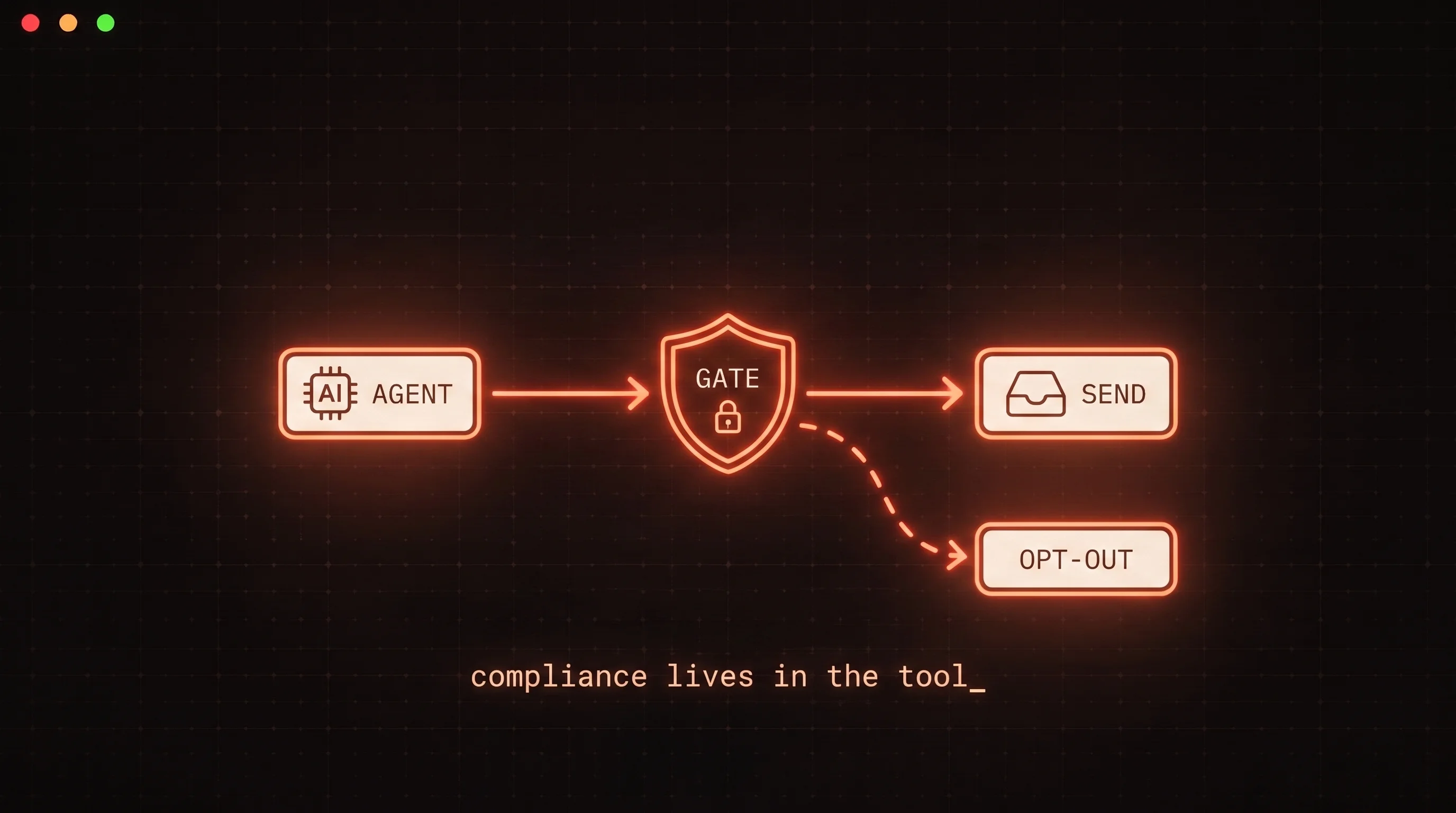
If you are running cold email through a dedicated send infrastructure rather than hand-rolling your own, the timing constraints belong in the send tool rather than in the agent's prompt.
The reason is the same one that applies to cold email inbox rotation and send limits: a prompt instruction is advisory. "Send only between 9 AM and 5 PM recipient local time, no faster than one send per 90 seconds" is a suggestion the model can follow faithfully on normal runs and still violate on the first unusual batch - a larger list than expected, missing timezone data, a retry loop firing faster than the prompt anticipated.
A send tool that enforces the rate limit on every call and queues sends outside the recipient's timezone window holds the constraint regardless of what the agent decided upstream. It converts the cold email send time policy from something the agent is asked to respect into something the infrastructure makes unavoidable.
This matters more as AI agent cold email deliverability scales. At low volume, a burst or a few timezone-blind sends has limited impact. At higher volume, the cumulative pattern in your send logs is what mailbox providers evaluate when assigning your domain's sending reputation. Consistent rate, consistent window, consistent daily volume - that is the signal that compound-builds over time. Burst events erode it.
A practical checklist
For anyone optimizing cold email send time, whether running manual sequences or agent-driven campaigns:
- Schedule sends for Tuesday through Thursday, 9 to 11 AM in recipient local time. Friday and Monday can work but have lower ceilings.
- Use per-recipient timezone fields on your lead records. Default to the campaign's primary geography for leads with missing location data.
- Enforce a minimum 60-to-90-second interval between consecutive sends from any single inbox.
- If your agent runs in overnight batches, ensure the send layer queues scheduled sends for the next business-day window rather than firing immediately.
- Pull send logs after large batches and check the maximum sends-per-minute from any single inbox. If it is above one per 60 seconds, you have a burst risk.
The cold email send time window is worth getting right - a 2.1 percentage point difference across enough sends is real pipeline. But it is secondary to the pattern your sends create in the logs, which is what determines whether your domain builds or erodes reputation over time.
If you are building an AI agent stack where the sending goes through an MCP-based cold email tool, rate limiting and timezone-aware windowing at the tool call layer means the timing is correct by default - the send pattern is compliant whether the agent runs at 9 AM or in the middle of the night, because the infrastructure owns the timing decision, not the agent.
That is the right framing for cold email send time in an AI-agent outbound stack: not a prompt instruction to be careful, but an infrastructure design where the right send time is the only send time the tool can produce.