The cold email infrastructure problem is mostly solved. Warmup is automated, inbox rotation runs at scale, send timing is enforced at the tool layer, and enrichment waterfalls routinely cover the majority of a prospect list. The AI agent knows what time to send, which inbox to route through, and what signal to reference in the opener.
And yet reply rates are not moving. Most AI SDR stacks land near the 3.43 percent average the Instantly 2026 Cold Email Benchmark Report documents across their user base. The top 10 percent of senders on that same infrastructure hit 10.7 percent or higher.
The gap is not infrastructure. It is cold email copy for AI agents - specifically, the problem that the model writes the opener, the body, and the CTA, and the output reads as generated. The teams at 10.7 percent are not running better warmup. They are writing better emails. Or more precisely: they are building systems where better emails come out.
The difference is not model quality. It is where in the stack the model is being asked to work.
What buyers actually recognize
Experienced B2B buyers now receive AI-generated cold email at high volume. (Illustrative observation, not a measured figure: sales teams across the industry report inbox saturation from AI SDR campaigns beginning in late 2024 and continuing through 2026.) The messages are technically personalized - they reference a funding round, a job posting, or a recent LinkedIn post - and structurally identical. The opener acknowledges a signal with perfect fluency. The transition connects that signal to a value proposition in one sentence. The body explains the value proposition in two or three clean paragraphs. The CTA asks for a low-friction next step.
The message is individually personalized. The pattern is universal.
What buyers have developed is not a distrust of AI exactly. It is pattern recognition for this structure. The signal reference is accurate but generic. The connection to the value proposition is too smooth to have been thought of by a person writing one email. The body uses the same sentence rhythm as the last twenty or so emails they received from different senders (as an illustration - the exact count varies by buyer and vertical, but the pattern is consistent). The CTA was optimized to convert rather than written to reflect what the sender actually wanted.
None of these are individual tells. Together, they read as generated.
The Instantly benchmark attributes the gap between average and top senders to micro-segmentation, problem-focused messaging, and hyper-relevant targeting. In practice, those three phrases describe one thing: proof that the sender understands the specific situation of this recipient. That proof is hard to produce structurally. It comes through in how the sentence was built, not just what data it references.
The structural tells of AI cold email copy
When an AI agent writes cold email copy from a prompt and a set of enrichment signals, the output tends to share several structural properties.
The opener is too complete. A human who spotted a relevant signal and fired off a cold email might write: "saw your Series B closed last week, congrats." An AI generating an opener writes: "I came across the announcement of Acme's Series B funding round last week and wanted to reach out with something that might be relevant to your current growth phase." Both reference the same signal. One sounds like a person had a thought. One sounds like a model was instructed to acknowledge the signal professionally.
The relevance is explicitly stated. Human writers trust the reader to make the connection between a signal and a value proposition. AI writers tend to make it explicit - "which aligns with the challenges teams like yours face at this stage" - because the model is producing a complete argument, not trusting the reader's inference. Buyers recognize the pattern because it appears in roughly the same position in every AI-generated email they receive.
The value proposition is universal under a specific surface. Enrichment data customizes what the email says, but AI generation tends to produce copy where stripping the company name leaves a sentence that works for any company in the same vertical. True specificity is different: it references a detail that would only appear in a message written for this company, not this company's type. This is the test - strip the company name and ask whether the opener still reads as specific.
None of these are unfixable. But they cannot be fixed by prompting the model to write less like an AI. That instruction runs into the same generation dynamics that produced the problem.
The copy architecture for AI agents
The reason most AI SDR implementations get cold email copy for AI agents wrong is that they assign the model to the job it does worst: generating original persuasive prose for a known recipient.
Language models are good at processing structured data, matching inputs to categories, and adapting existing text to a new context. They are less good at producing a sentence that sounds like a person thought of it specifically for one recipient - because that property of a sentence comes from a human mental model of the other person, not from a model producing likely tokens given a context window.
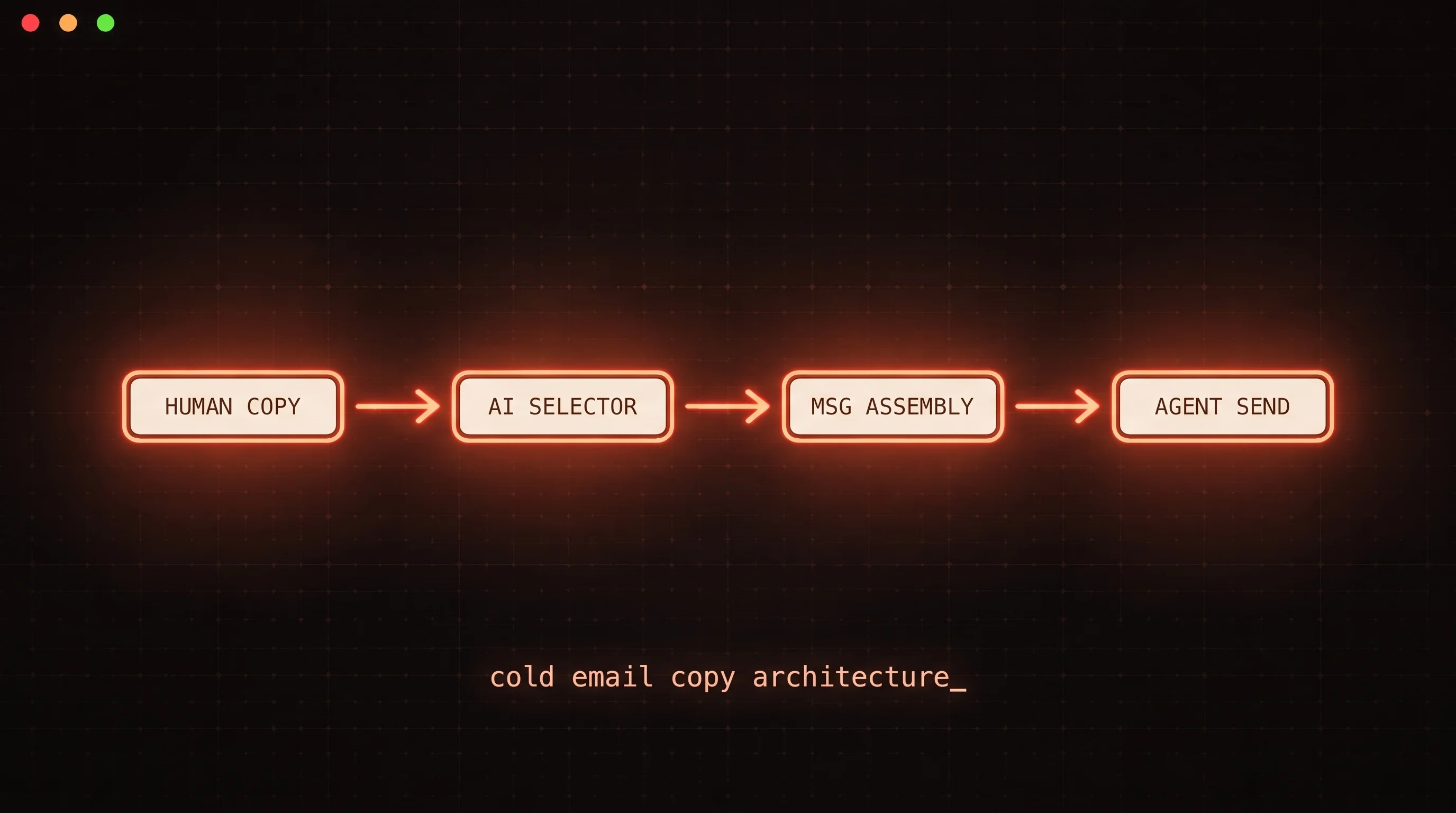
The architecture that works separates these roles explicitly.
Human-written first-line library. A copywriter or founder writes a set of first-line variants covering each signal type: a funding announcement, a job posting for the role you solve, a leadership change, a product launch, a recent LinkedIn post. These are written for the signal type, not for a specific company. The AI agent reads the enrichment output, identifies the most relevant signal type, selects the matching variant, and adapts the surface details.
Here is what this looks like in practice. Human-written first-line variant for a Series B signal:
congrats on the {round_size} round - curious if you're rebuilding the SDR function or scaling what's already working
What the AI adapts: {round_size} → "22M" (from enrichment), and optionally the closing question based on whether the enrichment shows an SDR job posting. What the AI does not change: the sentence structure, the casual opening word, the specific binary question at the end. Those came from a human who thought about what a genuine prospect would respond to.
The first line now reads like a person wrote it for this signal type, because a person did. The model's job was selection and adaptation, not generation.
Template body with AI-adapted middle sections. The body framework is human-written and campaign-tested. The middle two or three sentences - the ones that connect the signal to the specific account's situation - are the only section where AI is generating rather than adapting. Even here, the generation is bounded: the agent is filling in account-specific details in a defined section of a known structure, not producing the structure itself.
This is the same principle at work in cold email personalization for AI agents: personalization logic belongs in structured tool calls, not in an open-ended instruction to the model. Clay's cold email copywriting analysis confirms that first-email copy drives the majority of positive responses in a sequence - follow-ups rarely recover a first impression that read as boilerplate. The copy layer deserves the same architectural discipline as the enrichment pipeline.
Human-written CTA library. CTAs convert when they reflect what the sender genuinely wanted to ask. A small set of CTAs - written by a human, covering a quick question, a call ask, and a resource share - and the agent selects based on campaign type and prospect tier. The CTA does not need to be generated. It needs to be selected.
The model should be the operator of the copy process, not the author of it.
The recommended implementation is a tool call: the agent calls a select_email_variant tool that takes the enrichment signal type and account tier as structured inputs and returns a structured draft (first line, body scaffold, CTA) as the output. The model never writes a first line from a blank context; it selects and adapts from a library. This is the same design principle as the send tool enforcing rate limits regardless of what the prompt says - constraints on irreversible actions belong in the infrastructure, not in the model's discretion. The FoxReach MCP server is built on this pattern: tools receive structured inputs and return structured outputs that the agent assembles, rather than asking the model to decide what to write next.
Why this matters more as volume scales
At 50 sends per day from a single founder, a slightly generic opener has limited impact. The pattern is not yet detectable because the volume is low enough that few recipients have seen the same structure from someone else.
At 500 sends per day from an AI agent stack, the pattern compounds. The same generation process producing the same opener structure, at volume, means recipients in the same network or industry compare notes. The structural tell becomes a brand signal in the wrong direction.
Building an AI SDR that scales without degrading copy quality requires building the copy layer before the volume scales - not after. The template library is the infrastructure equivalent of domain warmup: it needs to exist before the agent runs at full speed, not be retrofitted after reply rates have already trended down.
The FoxReach MCP server treats the send layer as infrastructure because sends are irreversible. Cold email copy for AI agents works the same way: the agent should be selecting from known-good human-written components rather than generating the message under time pressure in a batch run that cannot be reviewed before it fires.
The one question that separates copy that lands
Before any AI-assembled cold email goes to production, one question cuts through most of the structural failures:
If the recipient stripped the company name from the opener, would the sentence still be specific to them?
If yes, the copy is working. If no - if the opener reads equally well for any company in the same vertical with the same signal type - the personalization is at the merge-tag level, not the message level.
That is where most cold email copy for AI agents fails, and it is not a problem the model can solve from inside a generation prompt. It is solved by the copy architecture, before the model runs.
The rule: if your agent is writing the copy from scratch, you have assigned it the wrong job - use AI to select and adapt human-written templates, and the structural detection problem goes away at the root.
That separation is what makes cold email for AI agents actually work at scale.