Is it legal for an AI agent to send cold email on your behalf? That is the question founders ask right after they wire an autonomous sender to a live inbox, and it is usually the wrong question. The law does not care whether a human or a model composed the message. It cares who is responsible for the send - and when an agent is doing the sending, the answer to who is responsible is not obvious to most of the people deploying one.
So let us answer the real question. Cold email compliance for AI agents is a liability question before it is a copywriting question, and the liability does not sit with the model, the framework, or the API. It sits with you. Understanding exactly why, and what the rules actually require, is the difference between an autonomous sender that scales your pipeline and one that scales your legal exposure.
This is engineering and operations guidance, not legal advice. The penalties and rules below are real, but your specifics are not - run your setup past counsel before you rely on any of it.
You are the controller, not the agent
Under the GDPR, the entity that decides the purpose and means of processing personal data is the data controller. When you deploy an agent to find prospects and email them to sell something, you decided the purpose. The model provider, the enrichment vendor, and the sending infrastructure are all processors acting on your instructions. Controllers carry primary responsibility for lawful processing, which means a compliance failure by your agent is a compliance failure by you.
The cleanest way to hold this in your head is to treat the agent as an employee. If you hired a junior SDR and they blasted a suppressed list, "the new hire did it" would not get you out of the fine. The agent is the same, except it works faster, never sleeps, and can turn one bad decision into ten thousand sends before anyone notices. The upside of autonomy and the liability of autonomy are the same property viewed from two angles.
The agent is a processor. You are the controller. A fine for an unlawful send lands on the business that deployed the agent, not on the AI vendor whose model wrote the words.
That framing is why the rest of this post is about controls you own, not disclaimers you hope the vendor carries.
What CAN-SPAM actually requires (US)
CAN-SPAM is an opt-out regime, not an opt-in one. It permits sending commercial email to someone who never asked for it, which is why cold email is legal in the US at all. In exchange, the FTC's CAN-SPAM compliance guide sets a short list of non-negotiables:
- Do not use false or misleading header information. The "from," "to," and routing must identify who actually sent the message.
- Do not use deceptive subject lines. The subject must reflect the content.
- Identify the message as an ad, where required, and include a valid physical postal address.
- Give a clear opt-out and honor it. You have ten business days to stop sending after someone opts out, and you cannot charge them or make them do more than send a reply or visit a single page.
The penalty is where autonomy changes the math. Each separate email that violates CAN-SPAM can draw a civil penalty that the FTC adjusts for inflation - currently more than USD 50,000 per message. For a human sending a few hundred emails a day, that ceiling is theoretical. For an agent that can generate and send thousands of messages a day, a single misconfigured run multiplies the exposure linearly. The law did not change for AI. The volume did.
What GDPR actually requires (EU and UK)
For recipients in the EU or UK, cold B2B email usually rests on the legitimate interest legal basis rather than consent. That basis is real, but it is conditional: the outreach has to be relevant to the recipient's professional role, you have to be transparent about who you are and where you got their data, and you have to make objecting effortless.
That last point is not a courtesy. Article 21 of the GDPR gives every recipient the right to object to direct marketing at any time, and once they do, "the personal data shall no longer be processed for such purposes." The right has to be presented clearly and separately at the point of first contact, and the recipient must be able to exercise it easily, including by automated means. In plain terms: your opt-out has to work on the first email, and your systems have to stop sending the moment someone uses it.
Get this wrong at scale and the numbers are not five figures. Article 83 caps fines for unlawful processing at the greater of 20 million euros or 4% of global annual turnover. An autonomous agent that keeps emailing someone who objected is not committing a small paperwork error. It is repeating a violation on every send.
The new layer: the EU AI Act transparency rule
There is a fresh piece of law worth understanding, because vendors are already overselling it. The EU AI Act's transparency obligations in Article 50 became applicable on 2 August 2026. They require, among other things, that people be told when they are interacting with an AI system and that AI-generated media be marked as artificial.
Read carefully, though, those rules are aimed at chatbots, deepfakes, and synthetic audio, image, and video - not squarely at a one-to-one sales email that a model happened to draft. Whether a cold email falls under Article 50 is genuinely ambiguous today, and anyone telling you the AI Act "bans AI cold email" is selling fear. The direct legal pressure on your outbound still comes from GDPR and CAN-SPAM.
What Article 50 does tell you is the direction of travel. Transparency about the use of AI is now a legislated expectation in the largest single market you are likely to email. Building disclosure and record-keeping into your stack now is cheap. Retrofitting it after enforcement patterns settle is not.
Why autonomous sending raises the stakes
Three things about an AI agent make compliance harder than it was for a human running the same playbook.
Volume multiplies every mistake. A person who misreads a rule sends a handful of bad emails. An agent that misreads a rule sends the whole run. As an illustration, if a misconfigured agent sends 5,000 messages before a human notices, and the run violated CAN-SPAM, that is 5,000 separate violations - the exposure is the per-email penalty times the whole batch, not times one.
The agent decides who to contact. When a model sources and enriches its own lists, it is making automated decisions about whose data to process. If the enrichment pulls job titles, intent signals, or profile data that was not lawfully sourced, you have a data-provenance problem baked into the pipeline, and the agent will happily scale it.
Data crosses borders by default. Every prospect record the agent reasons over may be sent to a model API in another jurisdiction. That is a cross-border transfer of personal data, and it is your responsibility to have a lawful mechanism for it, not the model provider's.
None of these are reasons not to run an AI sender. They are reasons to put the compliance controls somewhere the agent cannot bypass.
Where compliance controls belong: in the tool, not the prompt
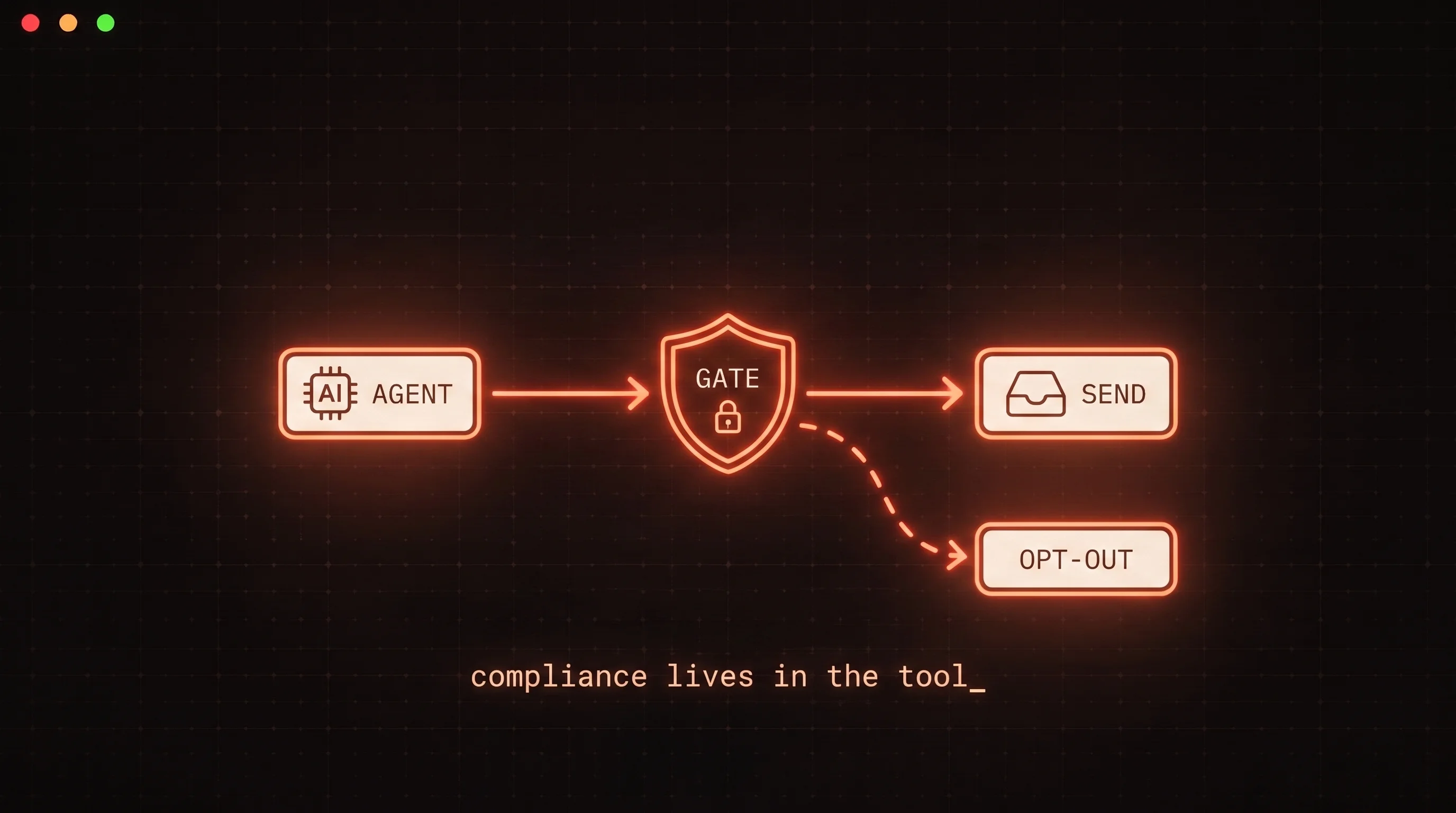
Here is the mistake that turns a compliant design into a non-compliant one: writing the rules into the agent's instructions. "Always honor opt-outs. Never email a suppressed contact. Include our address." A model can misread any of that, drift from it over a long run, or be talked out of it by an unusual input - and you will not find out until the sends have already left. This is the same lesson that governs AI SDR guardrails: a rule written in a prompt is a suggestion, and a rule written in the tool the agent calls is a limit.
Compliance controls belong at the send boundary, enforced in code:
- Suppression enforced in the send tool. Opt-outs, prior objections, and do-not-contact flags are checked on every recipient at send time, so a dirty enrichment step cannot leak a forbidden address into a live campaign. This is how you satisfy the Article 21 duty to stop on objection - mechanically, not hopefully.
- Honest identity in the headers. The sending system sets truthful "from" information and the required postal address, so no prompt can produce a deceptive header.
- An immutable audit log. Every send is recorded - who, what, when, and which checks it passed - because when a data-subject request or a regulator asks what your automated system did with someone's data, "we are not sure" is not an answer you want to give.
- A kill switch. One command halts all sending the minute you spot a problem, instead of a redeploy while the agent keeps working.
When outbound actions run through a governed cold email MCP server, those controls live in the boundary itself, so they hold whether the caller is a Claude agent, a LangChain script, or a cron job - and you enforce them once rather than re-implementing them in every agent you ship. The broader picture of how sourcing, sending, and reply handling connect around that guarded boundary is what cold email built for AI agents is about. For the sends that carry the most legal weight - a first touch into a sensitive market, a reply that changes the relationship - a human-in-the-loop checkpoint is the cheapest insurance you can buy.
A compliance checklist for an autonomous sender
Before you let an agent send without a human watching each message, confirm every one of these is enforced in code, not prose:
| Control | What it enforces | Where it lives |
|---|---|---|
| Lawful basis on record | A documented legitimate-interest assessment or consent, per contact | Data pipeline / CRM |
| Contact provenance | Every record has a recorded, lawful origin | Enrichment / import step |
| Suppression | Opt-outs and objections block the send on every recipient | Send tool |
| Honest identity | Truthful headers plus a valid physical address on every message | Sending system |
| Opt-out that works on email one | A functional, easy unsubscribe from the first send | Message template + send tool |
| Audit log | An immutable record of every send and the checks it passed | Send tool |
| Kill switch | Immediate halt of all sending | Orchestration layer |
If any row lives only in the agent's prompt, move it down into the tool and test that it actually blocks.
The decision rule
Compliance for an AI sender comes down to one line: if a rule is something you could be fined for breaking, it does not belong in the prompt - it belongs in the tool the agent cannot talk its way around. Put your opt-out, suppression, identity, and audit controls in the governed send layer first, then let the agent run. You are the controller either way. The only choice you get to make is whether your controls are strong enough to earn that title.