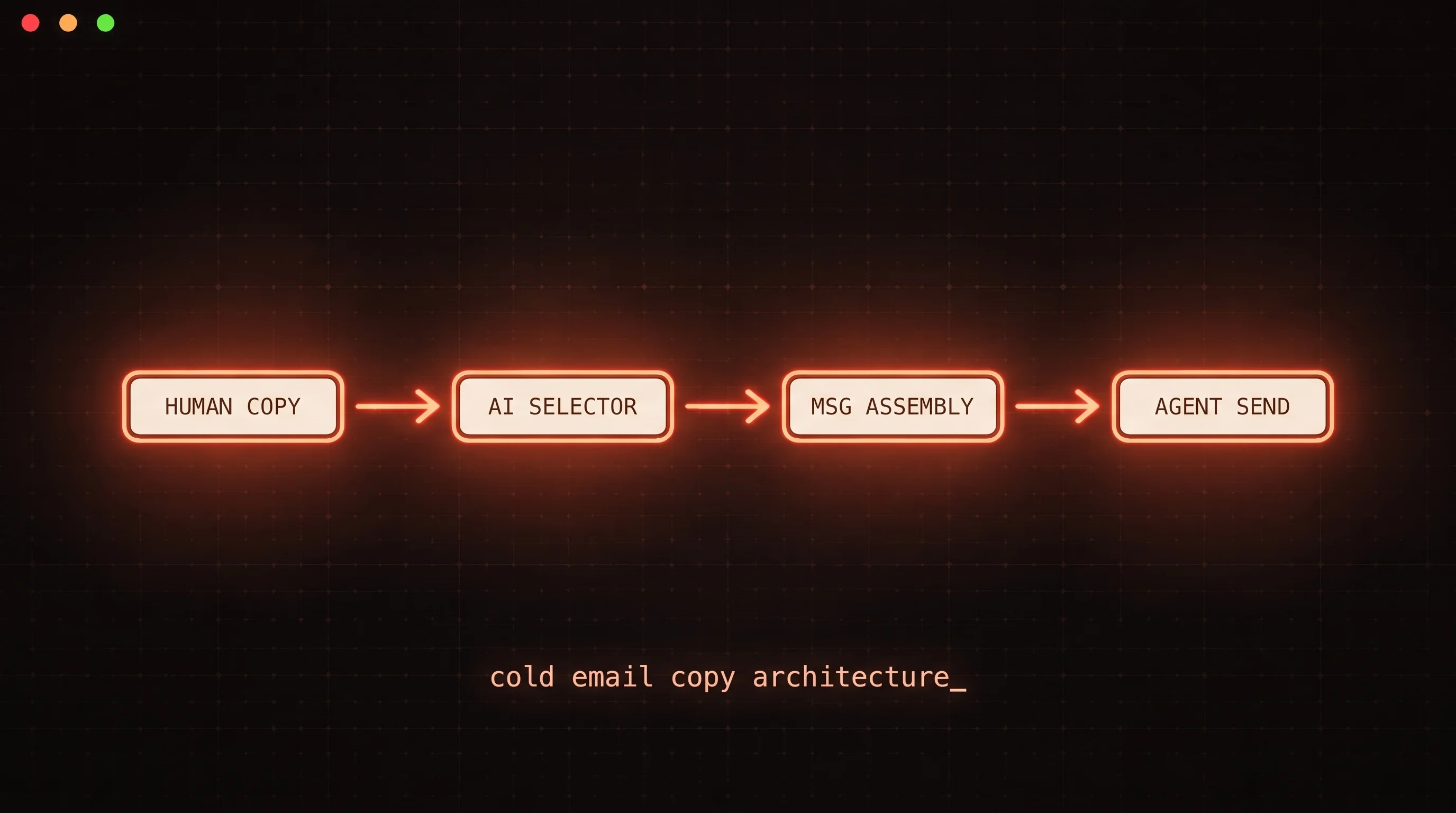
Every vendor selling "AI-powered outbound" in 2026 is describing the same product: a sequencer with a language model wired into the copy field. It writes your subject lines, it spins a few variants, it personalizes the first sentence from a LinkedIn bio. That is a better sequencer. It is not agentic outbound, and treating the two as the same thing is why so many teams try "AI outbound," see a marginal lift in reply rate, and conclude the category is overhyped.
Agentic outbound is a structural change, not a copy upgrade. The tell is simple: in a sequence, a human decides the plan in advance and the software executes it. In agentic outbound, the agent decides the plan at runtime and revises it as it learns. The sequence - the fixed step one, step two, step three that has been the atomic unit of outbound for fifteen years - stops being the unit at all. The unit becomes a decision the agent makes each turn.
What "the agent owns the motion" actually means
Strip away the marketing and an agentic system is one that makes decisions, adapts, and takes actions with little step-by-step human instruction. Gartner, tracking the same shift across all of enterprise software, predicts that 15% of day-to-day work decisions will be made autonomously by agentic AI by 2028, up from essentially zero in 2024. Outbound is one of the cleaner places to apply that, because the work is already a loop of decisions dressed up as a linear flow.
Here is the same account handled two ways.
In a sequencer: you import the contact, assign it to a five-step campaign, and the timer takes over. Day zero fires the intro. Day three fires the bump. If the prospect changes jobs on day two, the sequence does not notice - it keeps mailing the old address until a bounce or a manual edit stops it. The plan was frozen at import time.
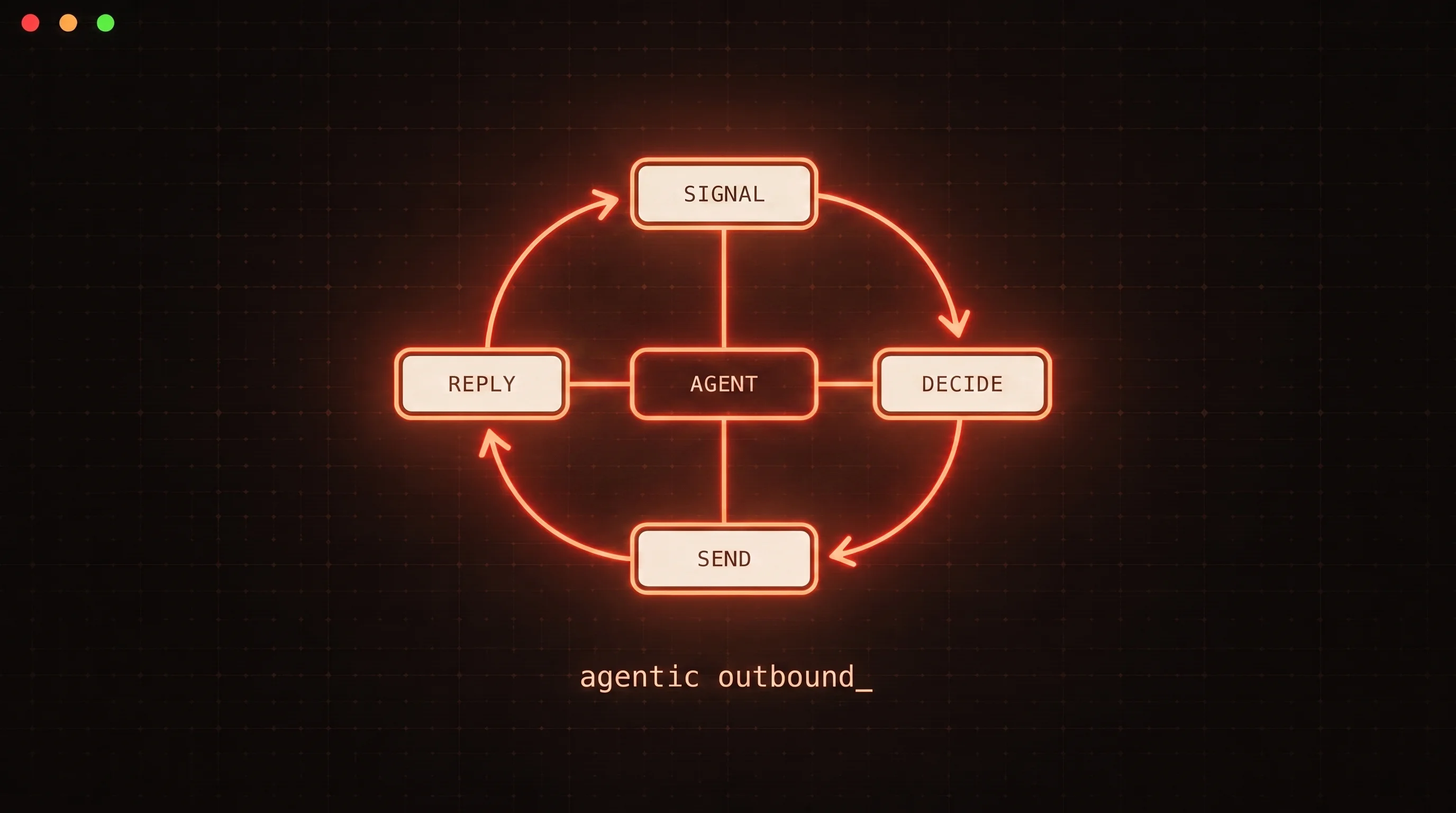
In agentic outbound: the agent picks up a signal - a funding round, a new hire, a job change - decides the account is worth touching, researches it, drafts a first message tied to the actual trigger, and sends. When the reply lands, the same agent reads it, decides it is a soft yes, and schedules a follow-up for Tuesday instead of a generic day-three bump. If the prospect changed jobs, the agent sees the new company in enrichment and re-decides rather than mailing a dead address. Nothing about that path was fixed in advance.
The difference is not that the second version writes better email. It is that the second version has no "step three." There is only the next decision, made against the current state of the account.
That is why "we added AI to our sequences" and "we run agentic outbound" are different claims. The first keeps the sequence in charge and lets a model fill in words. The second puts the model in charge of the motion and keeps the sending mechanics as tools it can reach for.
Three things that change when the sequence stops being the unit
The loop replaces the flowchart. A sequence is a directed graph a human draws once. An agentic system is a loop - observe, decide, act, observe again - that produces a different path for every contact. You stop maintaining branch logic ("if opened but not replied, wait two days, then send variant B") because the agent derives the branch from context each turn. This is the same architectural move an AI SDR represents at the role level: the worker that runs the loop instead of the operator who tends the flowchart.
The tool call replaces the CSV. In sequence-land, data moves between systems in batches - export leads, import to sequencer, sync replies back to the CRM overnight. In agentic outbound the agent needs to act on live state, so the send, the suppression check, the follow-up schedule, and the reply lookup all have to be callable in the moment. They become tools, not overnight jobs. This is exactly the problem the Model Context Protocol was built to standardize when Anthropic introduced it: a common way for an agent to reach the systems where the real state lives, instead of a pile of one-off integrations.
The decision moves from design time to runtime. This is the one that breaks legacy tools. A sequencer's entire value is that you decide once and it executes forever. Move the decision to runtime and the product's core assumption is wrong - there is no "campaign" to configure because the campaign is being composed live. You cannot retrofit that onto a system whose data model is "contact belongs to sequence." The unit changed underneath it.
The honest part: most of these projects fail
If agentic outbound were easy, everyone would already run it. The same Gartner analysis that projects the autonomy curve upward also predicts that over 40% of agentic AI projects will be canceled by the end of 2027, citing escalating cost, unclear value, and inadequate risk controls. In outbound specifically, the failure is almost always the third one.
The reason is unique to this domain: a cold email send is irreversible and externally visible. When you give an agent runtime authority over the motion, you also give it runtime authority over your sending reputation - and the model will occasionally decide wrong. It will re-mail a suppressed contact, blow past a per-inbox cap, or fire a generic sequence at an account another team owns. Google's email sender guidelines tell bulk senders to keep spam complaints under 0.3%, and ideally under 0.1%; a single confidently-wrong batch can cross that line and take a domain with it. The plan being dynamic is exactly what makes an ungoverned agent dangerous.
This is why the projects that survive are the ones that separate the agent's freedom to decide from its freedom to act. The agent can choose anything; the tools it calls refuse the choices that cross a hard line. That boundary is what AI SDR guardrails are - suppression, rate caps, and recipient allowlists enforced inside the send tool, not written as polite requests in the prompt - and it is why mature agentic outbound leans on human-in-the-loop cold email for the small set of decisions where a single wrong call is expensive. Autonomy over the motion, governance at the action boundary: that combination is what separates a shipped system from a canceled one.
What agentic outbound needs underneath
The thing legacy sequencers cannot provide is not intelligence - you can point any capable model at the problem. It is a send layer designed to be driven by a decision-maker that is not a human clicking a UI. Concretely, agentic outbound needs the outbound primitives exposed as typed tools an agent can call, with limits enforced in the tools:
- Leads and enrichment the agent can read live, not a nightly export.
- A send action that checks suppression and volume before it releases a message, every time, regardless of what the model decided.
- Follow-up scheduling and reply lookup as callable actions, so the loop closes inside one run instead of drifting across an overnight sync.
- Opt-out handling that fires instantly - the one place where speed is a legal requirement under the FTC's CAN-SPAM rules and a deliverability one under Google's guidelines.
That surface is what cold email built for AI agents means in practice, and it is the layer FoxReach is built to be: sending, suppression, follow-up, and reply infrastructure the agent reaches as tools, with the irreversible actions guarded below the model. Whether the agent reaches those tools over a hosted cold email MCP server or a plain API matters far less than whether the tools underneath enforce their own limits - because the whole premise of agentic outbound is that the plan is no longer fixed, and a dynamic plan needs a fixed floor beneath it.
Where this leaves the sequence
The sequence does not disappear; it demotes. The scheduled follow-up, the suppression list, the pacing rules - those survive as primitives the agent composes. What ends is the sequence as the organizing unit of outbound, the flowchart a human draws and the software obeys. The next two years of outbound belong to the teams that stop asking "what should my sequence do" and start asking "what should my agent be allowed to do," because the first question optimizes a template and the second builds a system. The vendors racing to graft a language model onto the copy field are answering the wrong question - and Gartner's cancellation number is the sound of that answer not working. Build the floor first, hand the agent the motion, and let the sequence become what it always should have been: a tool, not the plan.