Every cold email checklist you have read files verification near the bottom, under housekeeping, somewhere below subject lines and warmup. That ordering is exactly backwards. Copy and warmup decide whether a good list performs; verification decides whether you still have a sending domain next month. It is the cheapest step in the whole stack, and it is the one an autonomous sender is most likely to skip.
Consider the two numbers that bracket the problem. Business-to-business contact data goes stale at about 2.1% a month, which compounds to roughly 22.5% a year - a figure HubSpot's database decay simulation built on long-running MarketingSherpa research. A list you scraped, bought, or enriched in January is measurably wrong by February and substantially wrong by summer. On the other side sits the tolerance you get to work within: Google's email sender guidelines tell bulk senders to keep spam complaints under 0.3%, and ideally under 0.1%, and to stop sending to people who never engage. A decaying list feeding a razor-thin tolerance is a slow-motion reputation problem, and the cheapest place to interrupt it is the step most senders treat as optional.
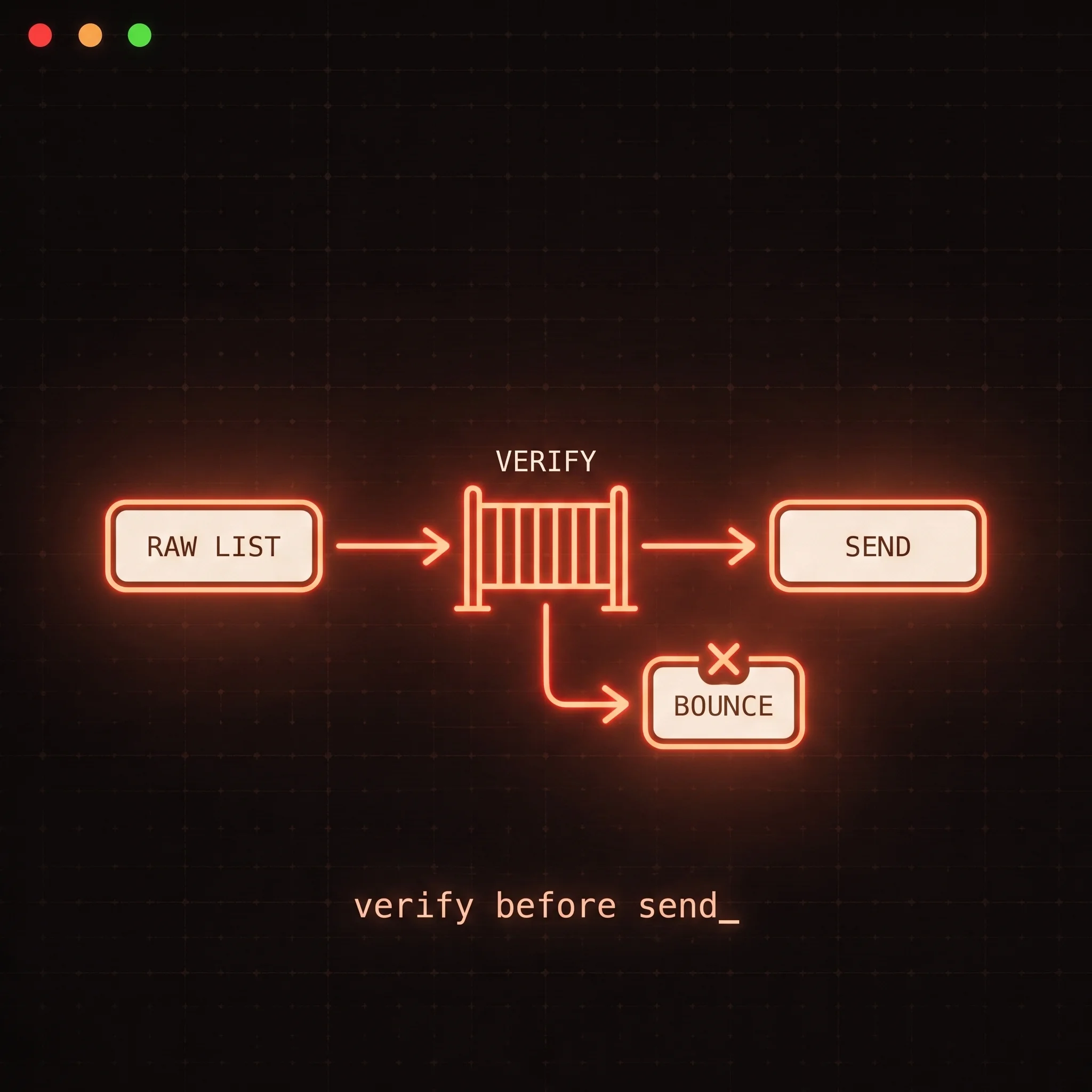
Email verification for cold email is that step. It is not glamorous, it does not write better copy, and it will not rescue a domain you already burned. What it does is stop invalid addresses from ever reaching your send - and for teams running autonomous outbound, it is the single gate most AI agents are missing.
What email verification for cold email actually checks
"Verified" is a word vendors use loosely, so it is worth being precise about what a real verification pass inspects. A good check runs a ladder of tests, cheapest first, and stops sending any address that fails a step it cannot pass:
- Syntax. Is the address even shaped like an email? Typos, stray spaces, and malformed domains die here for free.
- Domain and MX records. Does the domain exist and does it publish mail-exchange records? A domain with no MX cannot receive mail, so the address is dead no matter how it looks.
- Mailbox (SMTP) check. Does the specific mailbox exist on that server? This is the step that separates real verification from a regex, and it is done by opening an SMTP conversation without actually delivering a message.
- Catch-all detection. Some domains accept mail to any address, so the server says "yes" to everything. These get flagged as risky-accept-all rather than confirmed, because you cannot tell a real mailbox from a typo.
- Risk flags. Disposable domains, role-based addresses (info@, sales@, support@), known spam traps, and abuse addresses. Each of these is technically deliverable and each is a reason not to send.
The output you want is not a binary. It is a status - valid, invalid, catch-all, or risky - and a policy for what you do with each. Hard invalids never get sent. Spam traps and disposables never get sent. Catch-alls and role accounts are a judgment call you make once and encode, not a decision you improvise per campaign.
The point of verification is not to prove an address works. It is to remove every address you cannot prove works from a send where a wrong guess costs you reputation.
The chain that turns a bad address into a throttled domain
It helps to trace exactly how one dead address hurts you, because the damage is not the single bounce - it is what the bounce signals.
When you send to an invalid mailbox, the receiving server returns a hard bounce. A few of those are normal and forgiven. But mailbox providers track your bounce rate as a proxy for how well you know your own list, and a high rate reads as exactly one thing: this sender is mailing addresses they never confirmed, which is what spammers do. Cross a threshold and the provider stops giving you the benefit of the doubt. It throttles how much of your mail it accepts, routes more of it to spam, and lets your domain reputation slide - and domain reputation is the slowest asset to rebuild in all of outbound.
The operating targets are tighter than most senders assume. As a common rule of thumb, keeping bounces under roughly 2% is healthy, and past about 5% you are in territory where providers actively throttle delivery within a day or two. Treat those numbers as directional operating thresholds rather than hard published limits - the exact cutoff varies by provider - but the shape is not in dispute. Google's own guidance is unambiguous that sending to invalid and unengaged recipients is what pushes complaint and filtering signals the wrong way. Verification is the one lever that attacks this at the source, before a single bad address is ever handed to the send.
None of this replaces the rest of the deliverability stack. You still need authentication, warmup, and sane volume - our guide to cold email deliverability covers those layers, and verification sits underneath all of them as the data-quality floor. A perfectly authenticated domain sending to a junk list still bounces its way into the filter.
Why autonomous senders make this worse
Here is where the AI angle stops being a buzzword and becomes the actual reason to care.
A human running a campaign has a built-in circuit breaker. They export a list, they glance at it, they launch a send, and when a wall of bounce notifications comes back they stop and clean the list before the next batch. It is crude, but it works, because a person is standing between the data and the send.
An autonomous AI SDR removes that person on purpose. The whole value of an agent is that it sources contacts, enriches them, personalizes, and sends - at 2am, at volume, without waiting for anyone to look. Agents also generate dirtier data than humans do, because they scrape and infer addresses at runtime from patterns like first.last@company.com rather than pulling from a hand-checked CRM. So you have simultaneously increased the rate of bad addresses entering the pipeline and removed the human who used to catch them. That is not a small regression. That is the exact failure mode that makes teams distrust autonomous outbound, and it looks identical to the one we described in AI SDR guardrails: the model did precisely what it was told, and the result was still a send that should never have gone out.
The fix follows the same principle as every other guardrail. You do not solve it by asking the model, in its prompt, to please verify addresses first. A prompt instruction is a suggestion the model can skip, misread, or reason its way around. You solve it by making verification a step the pipeline enforces below the model, so the send simply cannot run on an address that has not passed.
Verification as a tool call, not a chore
Reframe verification from a cleanup task into a gate in the send path, and the whole problem changes shape.
In an agent-native stack, the actions your outbound system can take - enrich, verify, enroll, send - are exposed as discrete tools the agent calls. That is the model behind cold email built for AI agents, and it is what makes a hard verification gate possible: the send tool refuses to fire on any recipient whose verification status is not "valid," full stop. The check runs deterministically, in the infrastructure, in the milliseconds before the message leaves. The model can decide who to email and what to say; it does not get to decide whether an unverified address is worth the risk, because that decision lives below it in the tool.
This is precisely what a hosted cold email MCP server is for. When verification and sending are both tools with their own enforced rules, an agent that tries to send to a raw scraped address gets stopped by the tool, not trusted by the prompt. The gate holds no matter which framework or model made the call, which is the only kind of guarantee worth having when the action on the other end is irreversible.
Where to run the check, in order of leverage:
- At the point of capture. The moment an address enters your system - from a scrape, an enrichment call, a form - verify it. The cheapest bad address to handle is the one you never store.
- Immediately before the send. Data decays, and a status from three weeks ago is not a status. Re-verify at send time so the gate reflects reality, not history.
- On a rolling basis for anything reused. If you mail the same list twice, re-verify between sends. The 2.1%-a-month decay rate guarantees drift.
What verification will not do for you
Set expectations honestly, because oversold verification is how people end up disappointed. Verification confirms an address is deliverable and low-risk. It does not confirm the person is a good fit, that they want to hear from you, or that your message is any good. A verified list of the wrong people is a well-delivered failure.
It also is not a substitute for the reputation work. ZeroBounce and other vendors publish validation accuracy figures in the high-90s, and even at that accuracy, verification only governs the bounce lever. Authentication, warmup, content, and volume pacing are separate problems with separate fixes. Verification is the floor beneath them - necessary, cheap, and load-bearing, but not the whole house.
The rule is simple enough to hold in one line: never let your agent send to an address it has not verified in the same session, and enforce that in the send tool rather than the prompt. Wire that one gate - the FoxReach MCP server is built to hold it - and you have removed the fastest way an autonomous sender can quietly torch the one asset that takes months to rebuild.