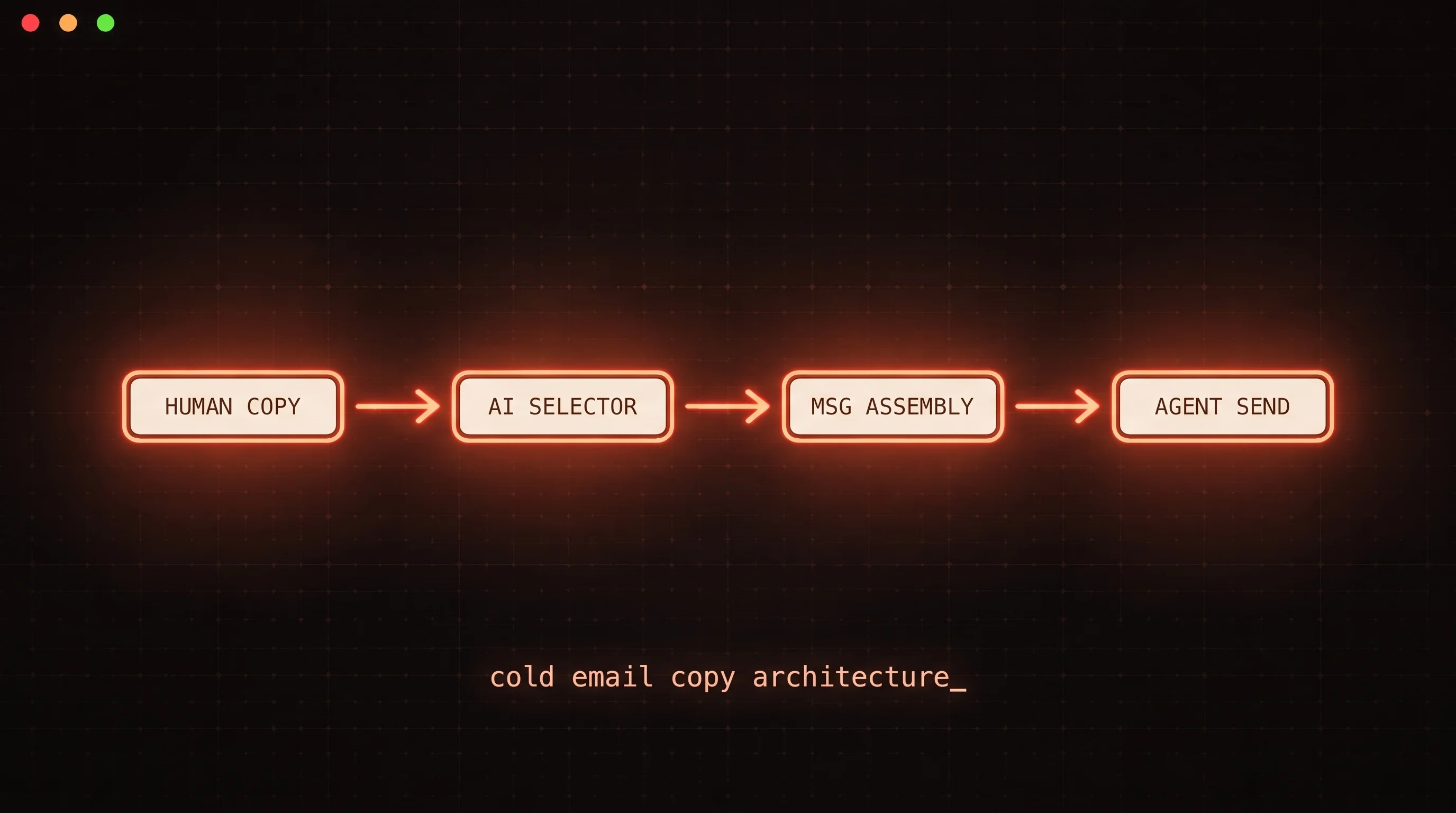
The best-known advice on cold email follow-up sequences goes like this: send five to seven touches, space them three to five days apart with widening gaps, vary the angle each time, and end with a clean break-up email. Continuas.ai's 2026 guide on cold email follow-up documents this cadence carefully, and it reflects real data from human-operated outreach refined over years.
The problem is the hidden assumption underneath all of it. That advice was built for people who forget.
Human SDRs drop follow-ups. Something pulls their attention and a thread ages past a reasonable window. The entire architecture of a classic cold email follow-up sequence - the scheduled intervals, the numbered touches, the break-up email at the end - exists to structure around human attention and human forgetting. When you hand the sending to an autonomous AI agent, the problem changes. The agent does not forget. It executes the sequence exactly as configured, on every contact, every time, regardless of how much else is happening. The failure modes shift completely.
What the standard advice was solving
The fixed-interval cadence is essentially a workaround for inconsistent human execution. Send touch two three days after touch one. Send touch three five days after touch two. Set it in the sequencer, lock it in, and the campaign runs even when the rep's attention is elsewhere. The sequence is a guardrail against omission.
An AI agent does not need guardrails against omission. It needs guardrails against commission - against sending when it should stop, against firing the next touch before a reply has been classified, against treating every non-response as permission to keep going. The design question shifts from "how do I make sure follow-ups happen" to "how do I make sure they stop at the right time."
This is the single biggest architectural error in agent-native outbound: taking the follow-up design built for humans who might forget, applying it unchanged to an agent that cannot forget, and then wondering why the domain reputation degrades or why contacts who replied negatively keep receiving messages.
The events that must end or pause a sequence
A human SDR reading a thread has implicit context. They see the reply, they read the tone, they decide this account is done. An agent needs explicit stop conditions because its context is whatever you gave it as a tool call result. Without a defined state for "stop," the agent's default is to continue.
These events should unconditionally change the sequence state:
A reply of any kind. Positive, negative, out-of-office, or ambiguous - any reply pauses the automated cold email follow-up sequence. The reply goes to autonomous reply triage or a human queue. Resuming automated touches after a real human has engaged is the fastest way to destroy a deal and a domain reputation at the same time.
A hard bounce. The address does not exist or is permanently unreachable. Remove it from all campaigns immediately. Continuing to attempt delivery after a hard bounce signals to mailbox providers that your list hygiene is poor, which raises spam classification risk for every other message you send.
An unsubscribe signal. Any signal that the contact does not want further contact - a direct "remove me," a GDPR deletion request, an unsubscribe link click - must suppress the contact across the entire system, not just in the current campaign. An agent that re-adds suppressed contacts from a new list import is the exact compliance failure that makes regulators take interest.
Sequence completion. When all touches have been sent without a reply, the contact is not "open." They are done for this cycle. The sequence-complete timestamp needs to be stored, and re-engagement must be blocked until the cooling window has elapsed.
A domain-wide suppression. If a company's email domain has been marked do-not-contact - because of a known competitor, a compliance flag, or a prior negative engagement - every contact at that domain should be excluded from the sequence, not just the specific address that triggered the flag.
A minimal agent-native four-touch sequence
The state machine defines when to stop. The sequence defines what to send - and why each touch earns the next one.
| Touch | Delay | Angle | Agent-specific note |
|---|---|---|---|
| 1 | Day 0 | Specific signal from prospect's recent activity or role | Must be written from enrichment data the agent fetched; no fallback template |
| 2 | Day 3 | A concrete outcome claim (not a feature list) | Only fires after a state check confirms no reply has been received |
| 3 | Day 8 | A different angle - peer reference, case study, or use case | Re-fetch enrichment before send; role or company data may have changed |
| 4 | Day 15 | Break-up email: short, no pressure, leaves the door open | Triggers the complete state transition once delivery is confirmed |
A few things change when an agent is sending rather than a human. Touch one's signal must come from data the agent actually retrieved - not a detail the model inferred or guessed. Touch two must differ in angle from touch one; an agent that generates both in sequence without a constraint on this will often produce near-duplicates. The break-up email is not optional: a sequence that ends by simply stopping leaves the contact in an ambiguous state from a CRM perspective, and the complete state transition should fire only after touch four is confirmed delivered, not when the scheduled date passes.
This is also where agent reply detection matters more than in human campaigns. If a contact replies after touch two but the reply arrives while touch three is already queued, an agent without a pre-send state check will deliver touch three into an active conversation thread. The state check inside the send tool is what prevents that - not a prompt instruction.
State machine, not calendar
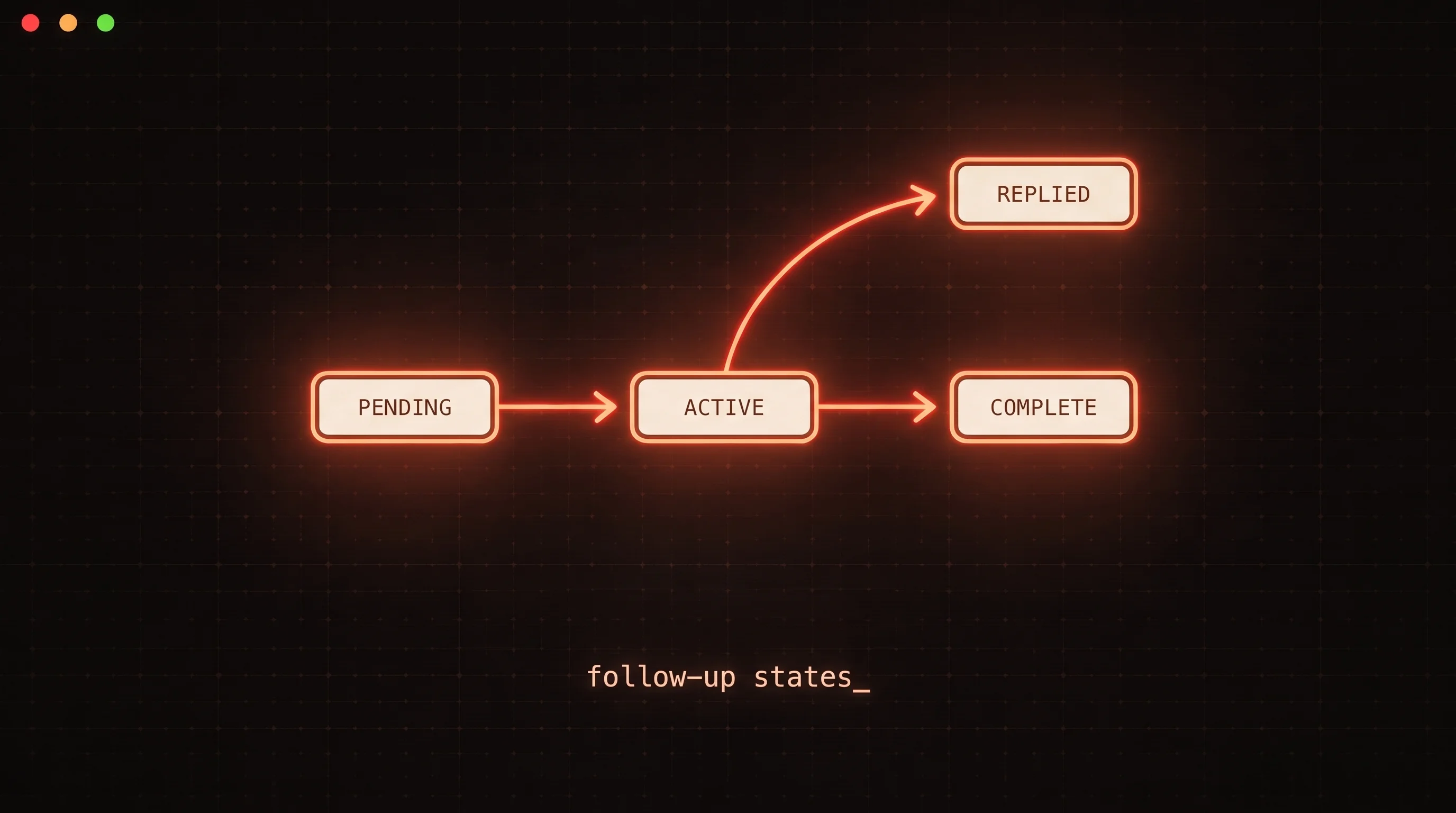
The cleanest mental model for agent follow-up design is a state machine rather than a schedule. Each contact is in one of a small number of states, and every event - a send, a reply, a bounce, a timer firing - either keeps the contact in its current state or moves it to a new one.
A minimal state machine for cold email follow-up looks like this:
| State | Description | What triggers the next transition |
|---|---|---|
| pending | Contact qualified, not yet sent | scheduling timer fires |
| active | In-sequence, awaiting reply | reply, bounce, unsubscribe, or all touches sent |
| replied | Reply received, automated sequence paused | human resolves (closes or moves to nurture) |
| bounced | Hard bounce, permanently removed | (terminal - no further sends) |
| complete | Sequence finished, no reply | re-engagement timer fires after cooling period |
| suppressed | Unsubscribed or flagged, never re-contact | (terminal - no further sends) |
The point is not the specific state names. It is the principle that every contact has a defined state, every event has a defined transition, and the agent's behavior follows from the state rather than from a freeform decision the model makes on each run. When the follow-up logic is a state machine enforced in the send tool, an agent cannot inadvertently email a contact who replied yesterday, because the contact is in the replied state and the tool rejects any send to a non-active contact.
An agent that decides in real time whether to follow up based on what it can infer from the thread is less reliable than one that reads the contact's state from a system of record and acts only on what the state permits.
This is the same principle behind human-in-the-loop cold email design: the autonomous layer handles volume, and the explicit state transitions define exactly where the human or the next agent takes over. The state machine is the interface between them.
Timing enforcement belongs in the infrastructure
The interval recommendations from human-sender research are still a reasonable starting point for a cold email follow-up sequence. Instantly's 2026 benchmark data, as reported by Unify, puts the sweet spot at four to seven emails, with the first touch capturing 58% of all replies and follow-ups driving the remaining 42%. That data makes the case for multi-touch sequences clearly - cutting the sequence short leaves nearly half of potential replies on the table. The Continuas.ai timing guide recommends spacing the touches at three days, then five, then seven, then ten, widening the gap as the sequence progresses.
Those intervals are a reasonable baseline. What changes for autonomous senders is where the timing enforcement lives.
In a human-operated sequencer, the schedule is a configuration setting that gets read when the next batch runs. The human may also check the timing manually and delay a touch that feels too soon. In an agent-native stack, the timing check needs to happen at the level of the send tool itself. If the send tool enforces a minimum interval since the last touch on that contact, the agent cannot override it through a retry loop, a batch decision, or a processing run that ignores the configured schedule. The interval becomes a constraint rather than a preference.
This matters because an AI agent processing 400 contacts at 2 AM will, without tool-level enforcement, fire the next touch for every contact that is due. Without a check on the per-contact last-touch timestamp inside the tool, the agent might compress three days of intended spacing into minutes if the prior touch timestamp was stored incorrectly or if a batch re-run replays work already done. The tool has to know when the last touch went out for each contact and refuse the call if the interval has not elapsed.
Suppression and deduplication live in the same layer. The tool controls the irreversible action. The agent cannot override it by deciding something different.
The reply is not always a stop - it is a branch
One subtlety that catches autonomous senders: not every reply is an end state. It is a branch point.
A positive reply goes to a human or to a specialized reply-handling agent. The cold sequence pauses. The account moves to a different pipeline stage.
A negative reply ("not interested," "wrong person," "we use a competitor") closes the contact for this campaign. The follow-up sequence stops, but the account stays in the system for potential re-engagement much later, under different circumstances.
An out-of-office auto-reply is ambiguous. The contact did not engage; they are just traveling. The right behavior is to pause the sequence for a few days and then resume - not to treat the out-of-office as a real reply that ends the sequence, and not to ignore it entirely and keep sending on the original schedule.
An autonomous agent needs these branches defined explicitly in the triage logic, not left to inference from the reply text. Autonomous reply triage covers the classification logic in detail. The follow-up sequence design and the reply triage design are two sides of the same system: one governs what goes out and when, the other governs what happens when something comes back.
Re-engagement is a separate flow
When a sequence completes without a reply, the temptation is to treat the contact as permanently cold and move on. The data suggests otherwise. The cooling period before re-engagement is real - Unify's 2026 cold email guide recommends waiting two to three months before re-approaching the same address - but contacts who did not respond to one sequence are not necessarily uninterested. They may have been traveling, out of budget cycle, or not in the right role at that moment.
The re-engagement sequence should be treated as a new outreach, not a continuation. The first message in a re-engagement flow should not reference the previous sequence by touch number or imply that the contact has been tracked. It should start fresh with a relevant new signal - a job change the agent detects via an enrichment API call, a product update you publish, a funding announcement - that justifies the re-contact on its own terms rather than simply the cooling period having elapsed.
For autonomous agents, the re-engagement timing must be stored and enforced the same way as in-sequence intervals. An agent given a new lead list that overlaps a prior campaign will re-contact a contact within days of their previous sequence completing unless the infrastructure has the sequence-complete timestamp and blocks sends until the cooling window has cleared. This is not a hypothetical failure mode. It is what happens when the state is stored in the agent's context rather than in a durable system of record.
What to check in your current setup
Pull the code or configuration that controls when the next follow-up touch goes out and ask three questions.
Does it block a send when the contact is in a replied, bounced, or suppressed state? If the sequencer checks a campaign-level setting but not a contact-level state, a contact who replied in a prior campaign may still receive touches in the current one.
Does it enforce the interval at the tool level, or does it rely on the agent choosing correctly? An agent that reads a calendar and decides on its own that "enough time has passed" is making a guess. A send tool that rejects calls when the minimum interval has not elapsed is enforcing a rule.
Is the sequence-complete timestamp stored and queried before re-engagement? If re-engagement is controlled by a new campaign setting rather than by a check against the last-sequence-end date for each contact, the cooling period depends on whoever sets up the next campaign remembering to exclude recent contacts.
If any of those have gaps, the fix is in the infrastructure, not in the prompt. The FoxReach cold email stack for AI agents stores contact state per contact, enforces per-contact timing at the MCP tool call layer - returning a structured error when the minimum interval has not elapsed or when the contact is not in active state - and emits state-transition webhook events so every send decision is auditable before it becomes a delivered message.
The one-line test for your current follow-up setup: if your agent had a bug and decided to re-process last week's contacts tonight, would the infrastructure stop it from re-sending, or would it send again and wait for you to notice in the morning logs?
If the answer is "wait for the logs," the follow-up logic is not in the right place.