

Create a Cold Email Campaign and Sequence in FoxReach (1 min)
Before you start
You need two things in the workspace before a campaign can send:- At least one connected email account. If you have not done that yet, follow connecting an email account to FoxReach. You can create the campaign without one, but you cannot start it.
- Some leads. Import a CSV or add them by hand, ideally with a tag so you can pull the right ones into the campaign later. See importing leads into FoxReach.
Step 1: Create the campaign
Open Campaigns in the sidebar and click New Campaign. The page is titled Create New Campaign and has four cards.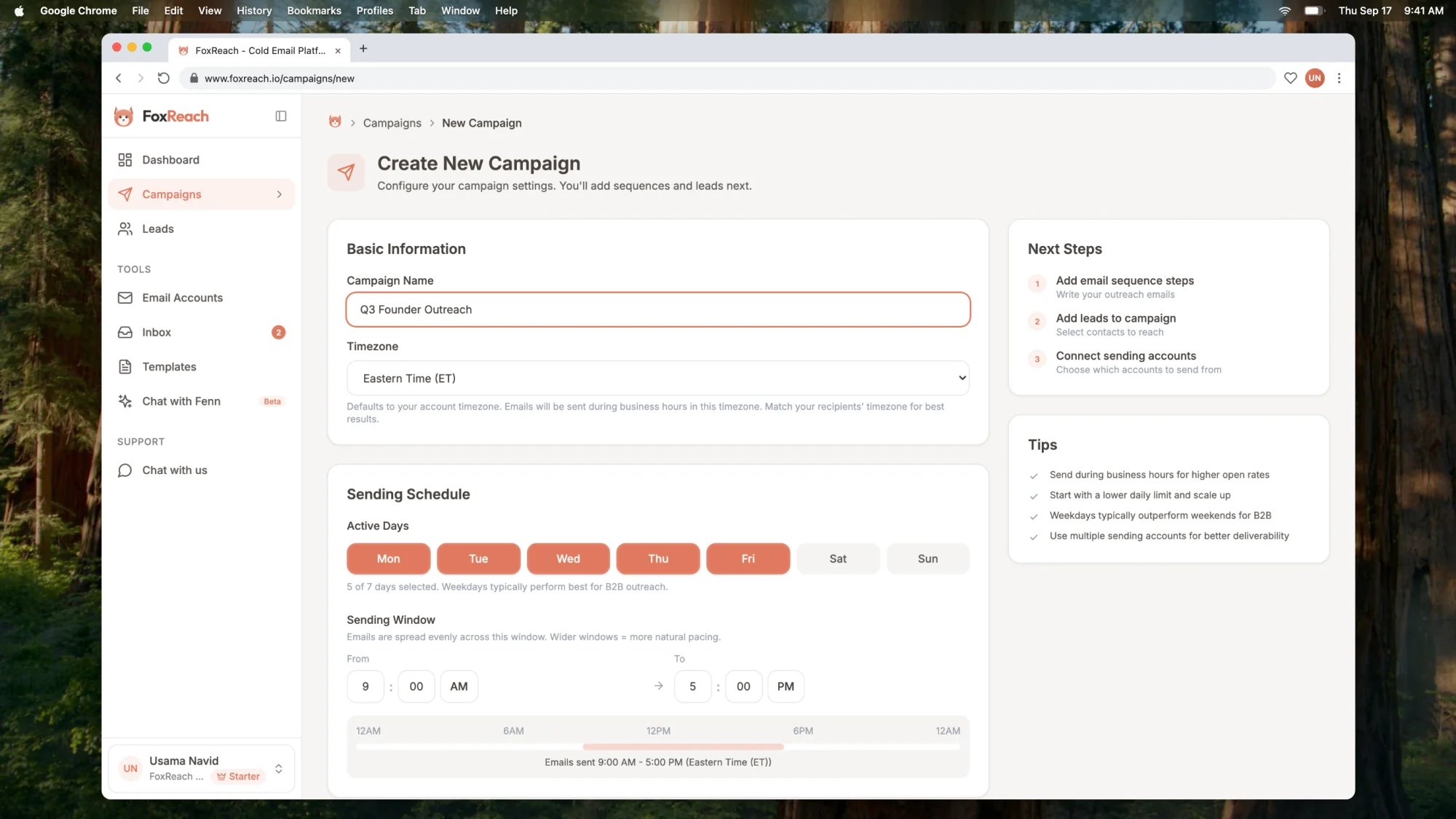
The Create New Campaign form in FoxReach with the campaign name, timezone, active days, sending window, sending accounts and daily send limit
Step 2: Write the first email
The campaign page has five tabs: Overview, Sequences, Leads, Accounts and Activity. Open Sequences and click Add First Step. An inline editor appears with a Subject Line field and a body editor. Write the subject, then click Variables next to it to insert a lead field at the cursor. The menu is grouped into Standard Fields (first name, last name, full name, email, company, title, phone, LinkedIn, website), Custom Fields (anything you imported that is not a standard column), and Account Fields (the sender’s signature, name and email).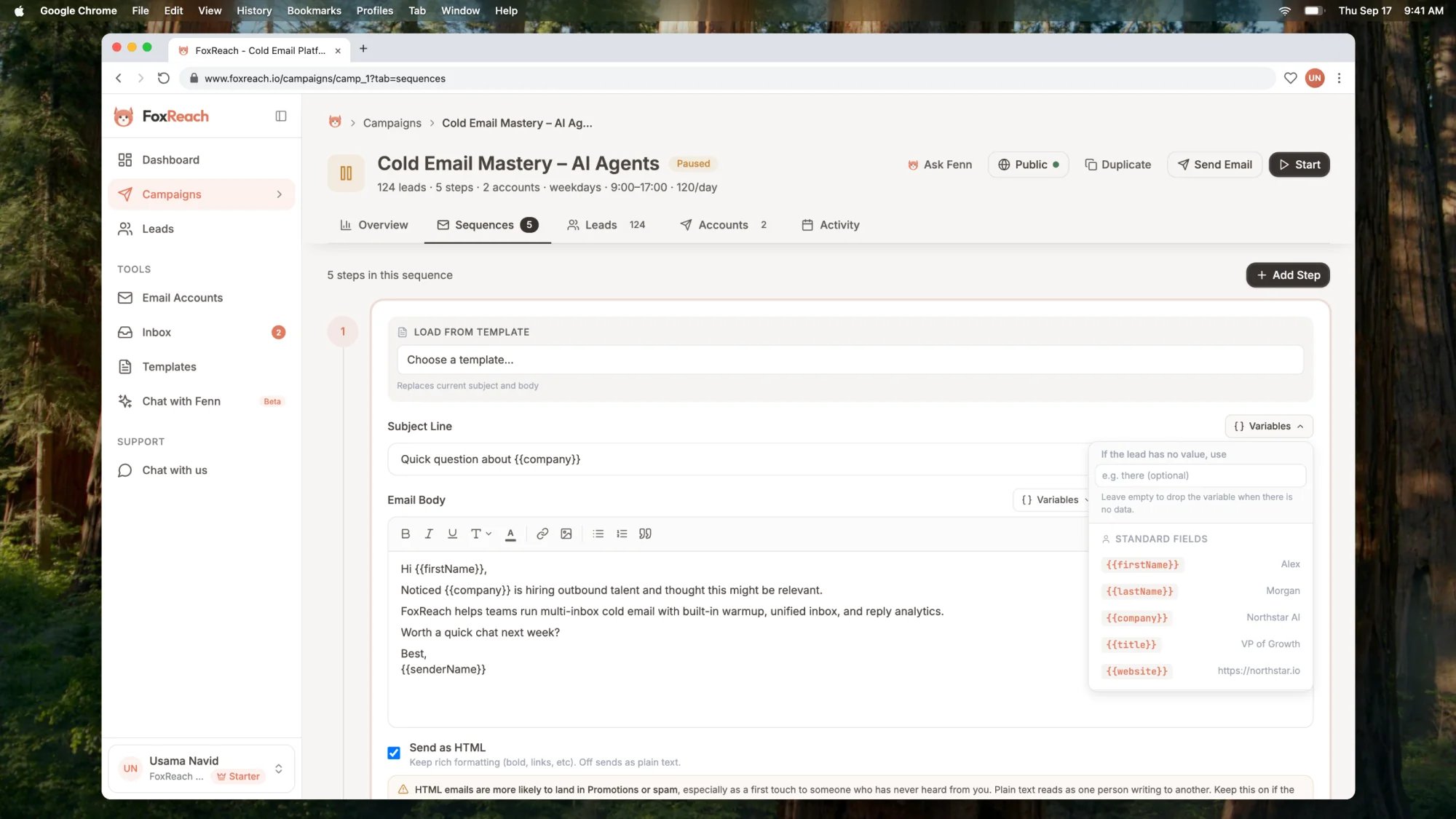
The sequence step editor with the Variables menu open above the subject line, listing standard, custom and account fields
- Variables look like
{{firstName}}and{{company}}. Snake case works too, so{{first_name}}is the same thing. - Fallbacks cover leads with missing data.
{{firstName|there}}renders the first name when it exists and “there” when it does not. In the Variables menu, the field labelled “If the lead has no value, use” bakes the fallback into the tag for you. - Spin syntax rotates phrasing per send.
{Hi|Hello|Hey}picks one option at random each time the step goes out, so no two emails are identical. Keep it to short phrases and never nest one block inside another.
{{company}} that would print an empty gap.
If you already have a template, the Load from Template dropdown at the top of the editor pulls its subject and body into the step. Templates are covered in email templates in FoxReach.
Click Add Step. A “Sequence step added” toast confirms it, and the step appears as a card.
Step 3: Add a follow-up
Click Add Step at the top of the Sequences tab. The editor is the same, with two extra fields that only appear from the second step on: Delay (Days) and Delay (Hours). The delay counts from the previous step, not from the first email. Three days is a sensible first follow-up; the follow-up sequence guide goes into spacing for longer sequences. Write a short bump, set the delay, and click Add Step. The card for step two shows “Wait 3 days after step 1” under its subject.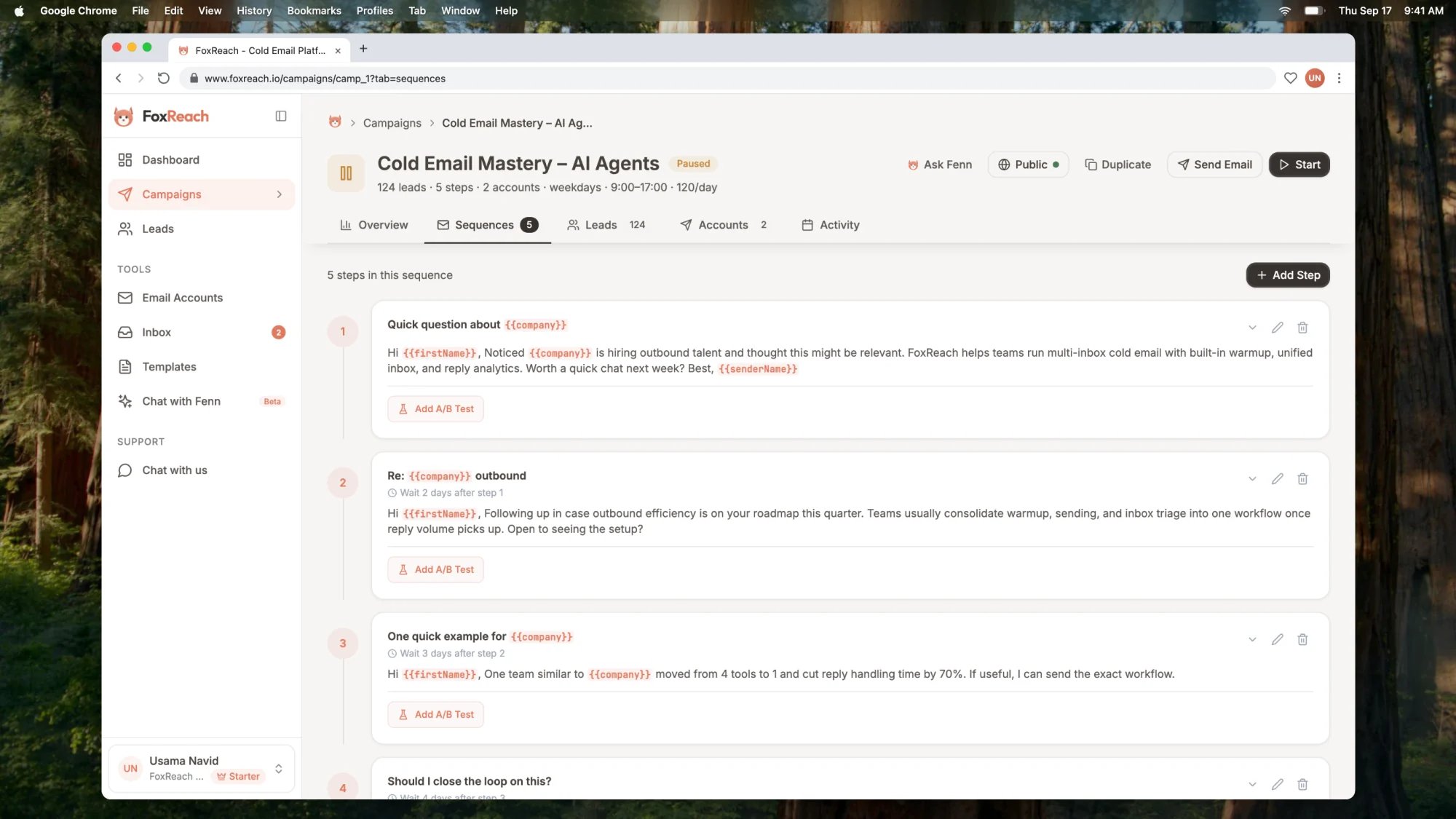
The Sequences tab of a campaign showing the ordered steps with the delay each one waits after the previous step
Step 4: Add leads
Open the Leads tab and click Add Leads. A panel titled Add Leads to Campaign slides in with a search box, a Status filter, a Tag filter, and a checkbox list of every lead in the workspace who is not already in this campaign.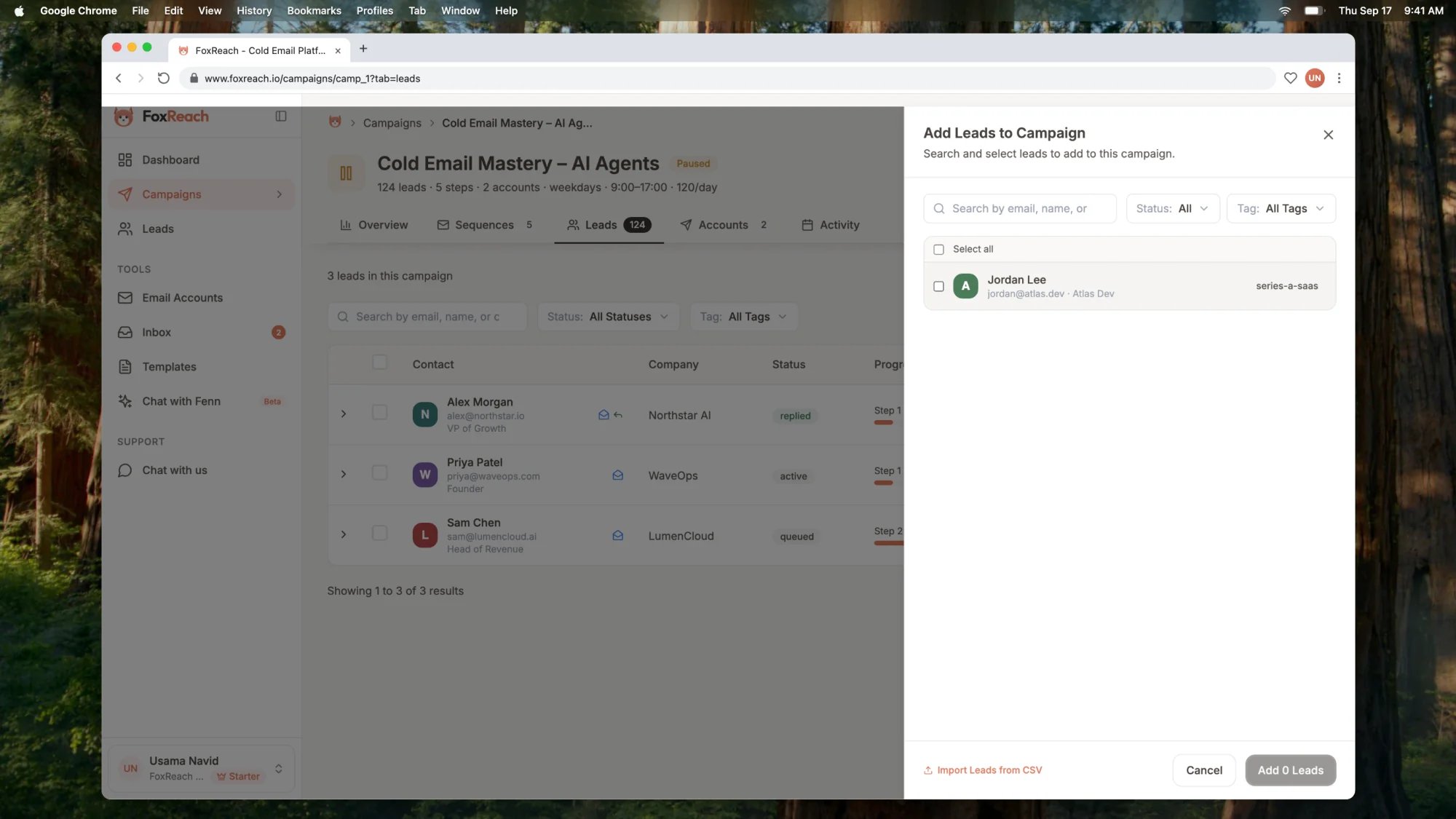
The Add Leads to Campaign panel with the search box, tag filter and the select all checkbox above the lead list
- Search by email, name or company to find individuals, like Alex Morgan at Northstar AI.
- Tag narrows the list to one imported segment. If you tagged your CSV on import, this is the fastest route.
- Select all ticks every lead on the page. If the filtered list runs past one page, a second link selects every matching lead across all pages.
Step 5: Check the accounts and start
Open the Accounts tab. The mailboxes you ticked when creating the campaign are already here. Use Add Account to attach another, or Remove to drop one. Now click Start at the top right of the page. FoxReach checks that the campaign has at least one sequence step, at least one lead and at least one account, then flips the badge from Draft to Active and shows a “Campaign started” toast. Sends begin at the next minute inside your window. Pause replaces Start while the campaign is active. Pausing cancels everything queued but not yet sent; nothing goes out until you click Start again, at which point leads pick up from where they were.How sending works once the campaign is live
A few things happen automatically that are worth understanding before you look at the numbers. The window and timezone are enforced. Sends only go out on the active days, between From and To, in the campaign’s timezone. If you set 9:00 AM to 5:00 PM New York time, a lead in London gets email between 2:00 PM and 10:00 PM their time, so choose the zone your leads live in. Volume is spread across accounts and across the window. Each day’s sends are divided among the selected accounts and paced through the window rather than fired in a burst. Two sends from the same mailbox are at least nine minutes apart by default, plus a random extra delay of up to five minutes. In an eight-hour window that works out to roughly 42 emails per mailbox per day; widen the window or lower the gap under Edit on the Overview tab to send more. Follow-ups come from the same sender and thread as replies. The account that sends step one to a lead is remembered, and every later step to that lead leaves from the same mailbox. Follow-ups carry the In-Reply-To and References headers defined in RFC 5322 and a “Re:” subject prefix, so Gmail and Outlook show the lead one thread. A reply stops the sequence for that lead. The moment FoxReach sees a reply, the lead is marked replied and no further steps are sent to them. Their reply appears in the unified inbox. Bounces are handled for you. A hard bounce marks the lead bounced in every campaign, and if a campaign’s bounce rate spikes, FoxReach pauses it automatically and emails you. Limits are checked at every send. The plan’s monthly email allowance, the workspace daily safety cap, the campaign daily limit and each account’s own limit are all checked again just before an email leaves. When any of them is hit, sending resumes when the counter resets. The campaign completes itself. When every lead has either finished the sequence, replied, bounced or been cancelled, the status changes to Completed and you get an email. Adding new leads to a completed campaign puts it back to Active. Two external rules shape these defaults. Google’s Email sender guidelines set the bar for authentication and complaint rates, which is why the pacing and account caps are conservative. The FTC’s CAN-SPAM compliance guide requires an honest sender, a truthful subject and a working opt-out, which is why every lead has an unsubscribe status FoxReach respects across all campaigns.Duplicating a campaign
Once one campaign is dialled in, click Duplicate at the top of its page. The copy keeps the schedule, the daily limit, the sequence steps, any A/B variants and the account assignments, and starts as a new draft. Leads are not copied, so open the Leads tab of the copy, add the next list, and click Start.Troubleshooting
Nothing is sending. Check four things in order. Is the badge Active, or still Draft? Draft campaigns never send. Is it inside the window right now, on an active day, in the campaign’s timezone? Has the daily limit been reached, either the campaign’s or every account’s? And does the Accounts tab show at least one account marked connected? A banner appears on the campaign page when no account can send. I cannot edit the sequence. Steps, settings and accounts are locked while the campaign is active, and the Sequences tab says “Pause the campaign to edit sequences”. Click Pause, edit, then Start again. Every email not yet sent uses the new content. The daily limit is lower than I set. Gmail and Microsoft mailboxes are capped at 50 sends a day regardless of the account setting, the workspace daily safety cap depends on your plan, and the nine-minute gap limits how many sends fit in a short window. The lowest cap wins. Compare the account limit, the plan cap on the pricing page, and the window length. A lead stopped getting follow-ups. That is the intended behaviour if they replied, bounced or unsubscribed. Open the lead in the Leads tab to see which one, and check the unified inbox for the reply. Start is refused. The campaign needs at least one sequence step, at least one lead and at least one connected account. The error names the one that is missing.Next step
The campaign is live. Replies will start arriving in the unified inbox, and that is where the next guide picks up: working the FoxReach unified inbox. Once a week or so of sends is in, reading campaign results in FoxReach explains which numbers on the Overview and Activity tabs matter and which to ignore. If you are bumping into the daily safety cap or the monthly email allowance, the pricing page lists the email limits on every plan so you can size the campaign to the plan you are on.Frequently asked questions
What is a campaign in FoxReach?
What is a campaign in FoxReach?
How does the campaign daily limit work with account limits?
How does the campaign daily limit work with account limits?
Do follow-ups come from the same email account as the first email?
Do follow-ups come from the same email account as the first email?
What happens when a lead replies to my cold email campaign?
What happens when a lead replies to my cold email campaign?
Can I edit a campaign after it has started?
Can I edit a campaign after it has started?